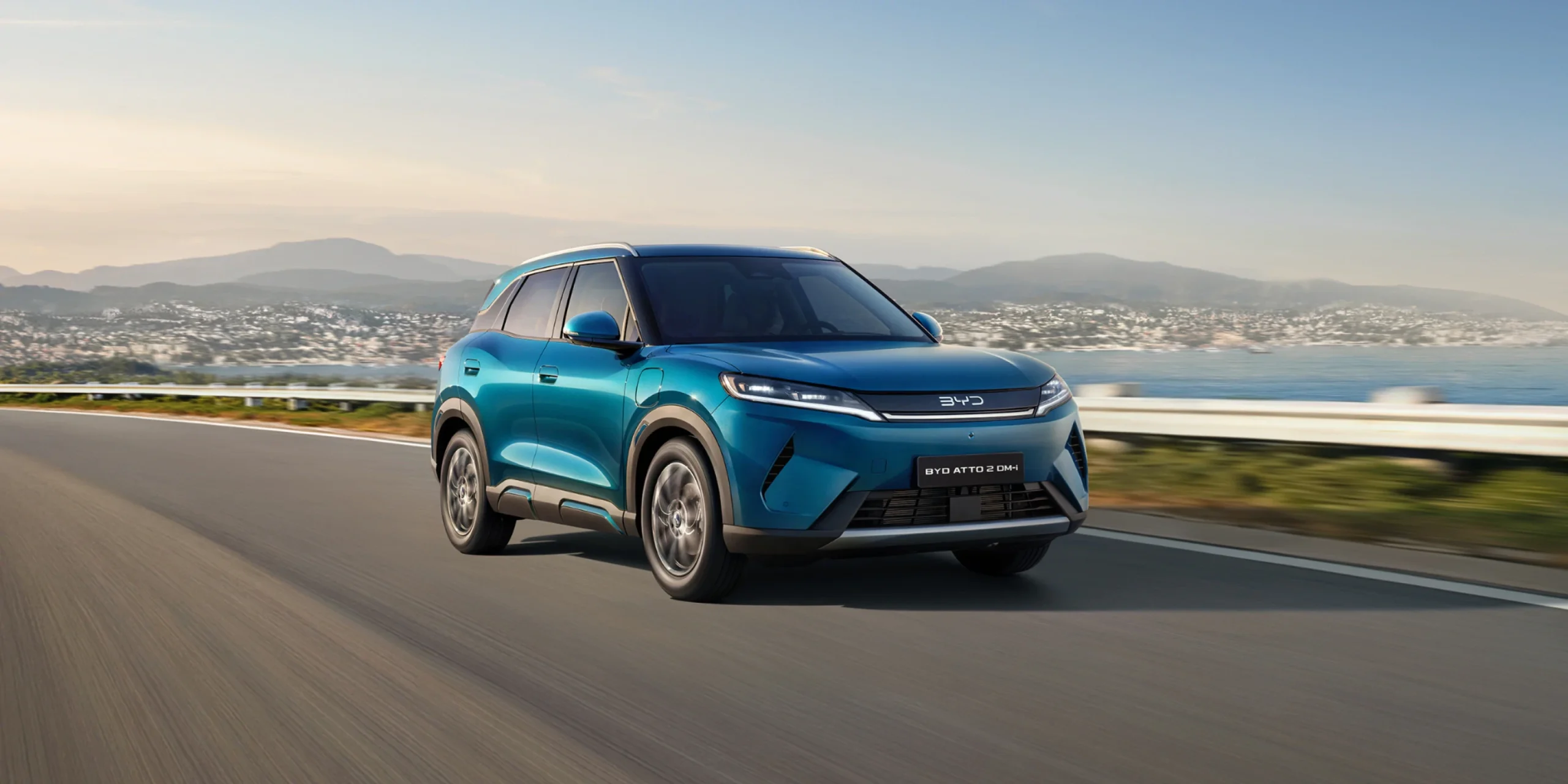
First Drive Review · PHEV SUV
£25,000 for a Plug-In Hybrid SUV With 56 Miles of Electric Range? BYD Just Did It.
The BYD Atto 2 DM-i lands in Britain as the most affordable — and arguably most disruptive — PHEV compact SUV on the market. But does the value story hold up in the real world?
Miles EV Range (Boost)
BHP (Boost)
MPG Real World
km Combined Range
Let’s start with the headline, because it deserves to be said plainly: BYD is selling a plug-in hybrid SUV, fully equipped, with over 50 miles of pure electric range, for around £25,000. That’s not a typo. That’s not a lease deal with a catch buried in the small print. That is the actual asking price of the BYD Atto 2 DM-i — and it may just be the most disruptive thing to happen to the British car market in years.
BYD arrived in the UK just three years ago. They already have eight models on sale. And with the Atto 2, they’ve brought their “Super Hybrid” DM-i technology down to the smallest, most affordable SUV in their lineup. At 4.3 metres long, it sits between a Renault Captur and a Toyota C-HR — city-friendly, family-practical, and on paper, extraordinarily well-equipped for the money.
So does it actually deliver? We’ve been behind the wheel. Here’s the full story.
Design: Clean, Inoffensive — and Deliberately So
We’ll be straight with you: the Atto 2 is not going to win any design awards. It won’t make your neighbour spill their coffee when you pull into the driveway. What it will do is look modern, tidy, and completely at home on any school run or supermarket car park in the country.
The standout detail is the full-width rear light bar incorporating ‘Chinese Knot’ inspired tail light graphics — a subtle nod to the brand’s heritage that actually works surprisingly well and gives the rear end genuine presence.
Up front, slim LED daytime running lights flank a neat grille, while 17-inch alloys fill the arches on all variants. The DM-i hybrid version is almost visually identical to the pure electric model — the only real giveaways are a slightly revised front air dam and, of course, a second filler cap on the rear quarter panel. Because yes, this one still drinks petrol when it has to.
If you’re coming from a Renault 4, a Kia EV3, or a Mini Aceman and you want something with genuine design personality, the Atto 2 may disappoint. It plays things safe. But if “looks modern and doesn’t embarrass me” is on your checklist — it absolutely ticks that box.
Interior & Technology: Where BYD Wins You Over
Step inside and the Atto 2 immediately starts building its case. The cabin feels genuinely well-assembled and thoughtfully laid out — which, at this price point, is not something you can take for granted.
The centrepiece is a 12.8-inch central touchscreen paired with an 8.8-inch digital instrument cluster. BYD has ditched the gimmicky rotating screen from previous models — apparently nobody actually used it — and the result is a cleaner, more intuitive dashboard layout. The vegan leather seats are comfortable, front seats are power-adjustable, and storage throughout the cabin is genuinely generous with cupholders, USB ports, and cubby holes front and back.
The Atto 2 is the first BYD to launch with native Google functionality built in — a significant upgrade for Android users especially, and a clear signal that BYD is serious about integrating properly into the UK digital ecosystem.
Rear passenger space is better than the external dimensions suggest. Adults can sit back there without feeling compressed. Boot space is practical for a car this size and the rear seats fold flat for extra cargo flexibility.
One recurring criticism that carries over from the wider BYD range: there are not enough physical buttons. Heating, lighting, and most comfort controls are buried in the touchscreen menus. On a cold January morning when you just want to turn the heat up quickly, navigating menus is genuinely frustrating. It won’t be a dealbreaker for most buyers, but it’s worth knowing before you commit.
Powertrain: The DM-i System Explained — And Why It Matters
This is where the Atto 2 earns its reputation. BYD’s Dual Mode Intelligent (DM-i) “Super Hybrid” system is a genuinely clever piece of engineering, and understanding how it works explains why the efficiency numbers are so impressive.
At its core is a 1.5-litre naturally aspirated petrol engine running on the Atkinson cycle — the same fuel-saving principle used in Toyota’s hybrid systems. But here’s the key distinction: in most everyday driving, that petrol engine is not powering the wheels. It’s acting as a generator, feeding energy to the battery, which then drives the front-mounted electric motor. In practice, you’re driving an electric car the vast majority of the time. The petrol engine only steps in to directly drive the wheels under sustained high-speed or heavy-load conditions.
164 bhp
209 bhp
The Boost variant’s 18.3 kWh battery delivers 56 miles of pure electric range — enough that most daily commuters will rarely need the petrol engine at all. BYD claims a combined range of up to 1,000 kilometres on a full tank and full battery charge. Real-world testing has returned approximately 80 miles per gallon when driven with a charged battery. That figure is not a test cycle anomaly — it’s achievable in genuine everyday use.
Our recommendation: stretch to the Boost if your budget allows. The 25-mile EV range on the Active is decent, but the Boost’s 56 miles is what makes this powertrain genuinely transformative for running costs.
Driving Experience: Efficient by Design, Not Exciting by Choice
The Atto 2 DM-i is not a driver’s car. That needs to be said clearly, and without apology — because BYD never intended it to be one.
In EV mode, it’s genuinely impressive: hushed, smooth, and with enough punch for confident urban and suburban driving. The transition between electric motor and petrol generator in hybrid mode is well-managed — you don’t feel the system hunting or hesitating in normal conditions.
Where the Atto 2 falls short is dynamic engagement. The steering is light. Very light. Bordering on disconnected. There’s minimal feel through the wheel and it doesn’t inspire confidence on faster, more demanding roads. The ride is comfortable and composed over typical town and motorway surfaces, but wind noise around the large wing mirrors becomes noticeable and tiring on longer journeys.
Rivals like the Volkswagen Golf eHybrid and Peugeot 308 PHEV are simply more involving and polished to drive. But for the Atto 2’s core audience — urban families, daily commuters, and company car drivers — comfort and efficiency matter far more than cornering feel. On those terms, it delivers exactly what its buyers need.
Practicality & Ownership: The Real-World Case
Charging the Boost is handled at 6.6 kW AC — a full charge overnight on a home wallbox. The Active drops to 3.3 kW. Neither variant supports DC rapid charging, which is a genuine limitation if you regularly need a quick top-up away from home. For a PHEV it’s a manageable compromise, but it’s worth noting.
Standard equipment across the range is exceptionally generous. Metallic paint, full LED lighting, automatic wipers, a rear-view camera, rear parking sensors, the 12.8-inch touchscreen, and Google integration all come as standard. The headline ownership benefit, however, is BYD’s six-year manufacturer’s warranty — one of the longest in the segment and a powerful statement of confidence in the product’s long-term reliability.
For company car drivers in particular, the Atto 2 DM-i deserves serious attention. PHEV Benefit-in-Kind tax rates combined with this price point create monthly tax savings that can be substantial — and with 56 miles of EV range covering most business commutes entirely on electricity, running costs can be genuinely minimal.
Pros & Cons
Who Should Buy It — and Who Should Skip It?
The BYD Atto 2 DM-i is not a perfect car. The steering is too light, the styling too cautious, the touchscreen dependency too stubborn. These are real compromises, and we won’t pretend otherwise.
But at this price — genuinely, honestly — it doesn’t need to be perfect. A plug-in hybrid compact SUV with 56 miles of electric range, 80 mpg real-world economy, a 12.8-inch touchscreen, native Google integration, and a six-year warranty for around £25,000 is a remarkable piece of engineering and an extraordinary value proposition. Nothing else in this segment comes close on that combination.
BYD is playing a long game in Britain. They are getting better with every single model. And the Atto 2 DM-i may well be the car that converts thousands of British drivers to the brand. When value this compelling meets everyday practicality this solid — that’s a powerful combination, whatever badge is on the bonnet.