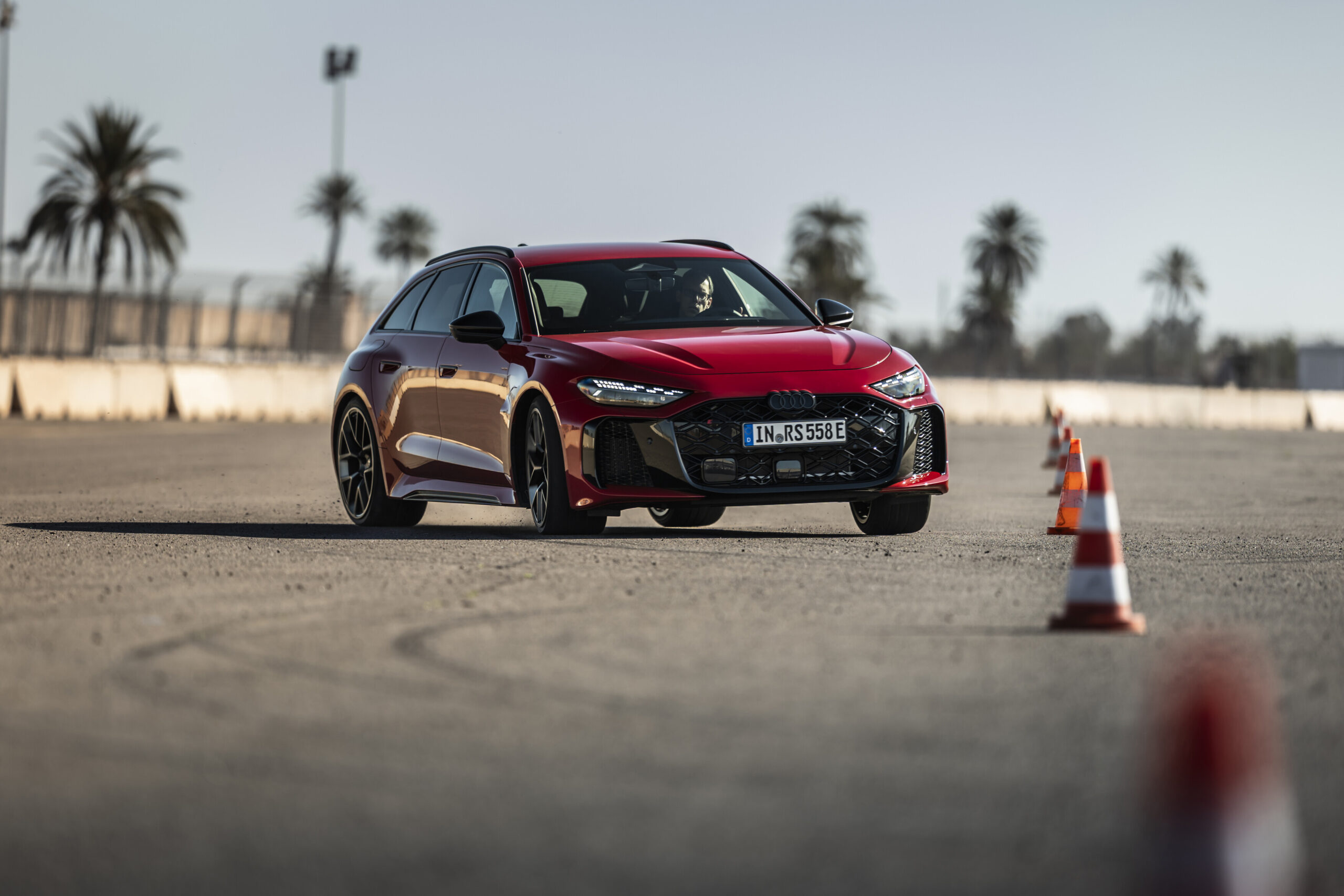
The Audi RS 5
Just Broke Physics
639 PS. 84 km of pure EV range. A world-first electromechanical torque vectoring rear axle. The new RS 5 isn’t just surviving the hybrid era — it’s weaponizing it.
SYSTEM PS
0-100 KM/H
EV RANGE
NM TORQUE
The Hybrid That
Dares to Be an RS
For years, “hybrid” was a dirty word among driving purists. Heavy, compromised, and clinical. But Audi Sport just dropped a 5,200-pound gauntlet that proves electrification and flat-out performance are a match made in Ingolstadt heaven.
Let’s address the elephant in the room: the combustion-only era is fading. Enthusiasts have watched the transition with creeping anxiety, fearing that sports cars will lose their soul. The all-new 2026 Audi RS 5 is Audi’s loudest possible rebuttal. This is Audi Sport’s first-ever high-performance plug-in hybrid (PHEV), and rather than using batteries merely to pass emissions tests, they have used them to fundamentally solve the handling limitations that have plagued front-engine, all-wheel-drive cars for decades.
We flew to Marrakesh, Morocco, to push the new RS 5—both the sleek Sedan and the iconic Avant—through the grueling, dusty switchbacks of the Atlas Mountains and onto the Circuit de Marrakech. What we found was a 470 kW (639 PS) monster that defies its curb weight with a world-first electromechanical rear transaxle. If you thought the fast estate was dead, you were wrong. It just evolved.
“Our electromechanical torque vectoring at the rear axle, together with the RS sport suspension, use that weight smartly. The result is a new RS 5 that drives with more precision and stability but still feels agile and light on its feet.”
— Rolf Michl, Managing Director, Audi Sport
Numbers That
Don’t Lie
* Fuel consumption (weighted, combined): 4.3–4.4 l/100 km. CO₂ emissions: 86–100 g/km. On discharged battery: 9.5-10.1 l/100 km.
The V6 Hybrid
Hammer
Two power sources. One devastatingly cohesive powertrain. This is how you build a hybrid that doesn’t feel like a compromise.
The heart of the new RS 5 is a heavily revised 2.9-liter twin-turbo V6 engine. On its own, the combustion unit produces 375 kW (510 PS), a massive 44 kW bump over the previous generation. Audi achieved this using a modified Miller cycle for better partial-load efficiency, variable-geometry turbos, and, for the first time in the RS 5, water-to-air intercoolers.
But the real headline is what it’s paired with. Sitting alongside the V6 is an external-rotor electric motor that adds 130 kW (177 PS) and 460 Nm of torque. Combined, you are looking at 639 PS and 825 Nm of twist. Hit the dedicated boost button on the steering wheel, and the RS 5 deploys maximum combined power for 10 seconds, catapulting you from 0 to 100 km/h in a blistering 3.6 seconds. There is absolutely zero turbo lag; the electric motor instantly fills the gaps while the turbos spool up.
Power is routed through an eight-speed tiptronic transmission equipped with an external cooler to handle the immense thermal load of track driving. The shifts are violent in RS mode, yet buttery smooth when you just want to glide through town on electricity.
Beating Physics
With Code
Historically, fast, front-engine Audis have had a reputation for nose-heavy understeer. The new RS 5 solves this with a world-first production technology.
Forget everything you know about traditional mechanical torque splitters. Audi has installed a dedicated, water-cooled 400-volt electric motor right inside the rear transaxle. They call it quattro with Dynamic Torque Control. This high-voltage actuator’s sole job is to actively vector torque left and right.
A central supercomputer (the HCP1) calculates the optimal distribution 200 times per second. It can flexibly shift up to 2,000 Nm of torque differential between the left and right rear wheels in just 15 milliseconds—roughly a tenth of the blink of an eye.
Preloaded Center Diff
Always partially locked to support rapid turn-in and completely eliminate internal understeer, even off-throttle.
Bidirectional Vectoring
Unlike mechanical clutches, the electric actuator can push torque in either direction—even when you are slamming the brakes.
Twin-Valve Shocks
New RS sport suspension independently controls compression and rebound, keeping the 5,200-lb car shockingly flat.
We tested this on the winding, dusty switchbacks of the Atlas Mountains. Enter a tight bend too hot, and the system instantly pulls torque from the inner wheel, shoves it to the outer wheel, and physically rotates the car into the apex. It feels like a video game cheat code. The dreaded Audi understeer is entirely dead.
The Market: Buying New vs. Pre-Owned RS Models
If the €106,200 base audi rs5 price feels a bit steep, or if you simply prefer your cars without a battery pack, the secondary market is incredibly active. Whether you are hunting for an audi rs5 for sale or specifically an audi rs5 sportback, the outgoing combustion-only B9 generation remains an absolute legend.
Buyers looking for a used audi rs5 or an audi rs5 coupe for sale have plenty of sweet spots to choose from. Early models like the 2018 audi rs5 and 2019 audi rs5 offer the pure 2.9L V6 experience at a heavy discount. Moving up, the 2020 audi rs5 and 2021 audi rs5 brought welcome tech updates. However, recent years are fiercely sought after—if you spot a pristine 2022 audi rs 5 (including the highly practical 2022 audi rs5 sportback) or an audi rs5 2022 model, expect the rs5 price to hold strong.
The final combustion years command the highest premiums. The 2023 audi rs 5—whether you are looking at the traditional 2023 audi rs 5 coupe, the 2023 audi rs5 sportback, or what some search for as the 2023 audi rs 5 hatchback—is the pinnacle of the pure-gas era. If you are typing “2023 audi rs 5 for sale” or “2023 audi rs5 for sale” into classifieds, be prepared to act fast on a good used rs5.
But be warned: the new 2026 PHEV audi rs 5 effectively replaces both the rs5 coupe and the rs5 sportback (and the old V8 audi rs5 convertible is long gone). The ultimate audi a5 rs evolution is here. If you want the pinnacle of cornering technology, the hybrid is the undisputed king.
Muscular, Wide,
and High-Tech
Visually, the new RS 5 is stunning. Sitting nine centimeters wider than the base A5, it features massively flared fenders—a direct nod to the legendary Audi Ur-quattro. Up front, a three-dimensional honeycomb Singleframe grille is flanked by darkened Matrix LED headlights that perform a checkered-flag digital signature when unlocked.
Step inside, and you are greeted by an ultra-modern, driver-oriented command post. The slim, curved OLED Audi MMI Panorama display combines an 11.9-inch virtual cockpit with a 14.5-inch touch screen. The telemetry available is staggering: you can view real-time energy flows, tire temperatures, and transmission heat levels.
The heavily bolstered RS sport bucket seats feature honeycomb quilting and standard massage functionality. If you opt for the Audi Sport package, the cabin is swathed in Dinamica microfiber with stunning Serpentine green and brass contrast stitching. It is a premium, highly tactile environment that perfectly balances luxury and motorsport aggression.
The Ultimate
Daily Driver?
The brilliance of the RS 5 PHEV is its duality. Tucked under the trunk floor is a 25.9 kWh battery (22 kWh net). This provides up to 84 kilometers of pure electric range, stretching to 87 kilometers in stop-and-go city traffic. You can do the school run, commute to work, and sit in traffic in complete silence without burning a drop of fuel.
With an 11 kW AC charger, the battery tops up in 2.5 hours. More importantly, the system is deeply integrated into the car’s performance logic. If you select RS sport or RS torque rear (drift mode), the car actively holds the battery state of charge at 90% and cools the pack to an optimal 20 degrees Celsius. This guarantees you always have maximum electric torque ready for aggressive cornering or track days.
Pros &
Cons
✓ The Good Stuff
- World-first electromechanical torque vectoring actually cures Audi’s historical understeer.
- Mind-bending 639 PS and 825 Nm of combined torque eliminates all turbo lag.
- Up to 87 km of real-world city EV range makes it an incredibly efficient daily commuter.
- Twin-valve suspension delivers a flat, track-ready ride that still soaks up city potholes.
- Aggressive, widebody styling is genuinely stunning, especially in the Avant shape.
- Segment-first ceramic brakes at the rear drop stopping distances dramatically.
✕ The Caveats
- The weight penalty: 2,355 kg (5,200 lbs) is impossible to ignore during heavy, sustained braking.
- Fuel economy plummets (10.1 l/100km) once the battery is completely discharged.
- Pricing is steep; starting over €106,200 before you even touch the Audi Sport package.
- Powertrain complexity is massive; out-of-warranty repairs in a decade will not be cheap.
- Purists will miss the raw, unassisted, purely mechanical feel of older RS generations.
The Real
Questions
✓ Why You Should Consider It
If you want the ultimate “one-car garage.” It can be a silent, comfortable, zero-emission commuter on a Tuesday, and a 639-horsepower supercar-slayer on a canyon road on Sunday. It blends extreme tech with brutal speed seamlessly, and the Avant version offers genuine family-hauling practicality without sacrificing pace.
✕ Why You Might Skip It
If you are a hardcore driving purist who values lightweight, analog chassis feel above all else. If you want a raw, unassisted driving experience and hate the idea of plugging your car into a wall, you might want to look at the pre-owned combustion market. The sheer weight of this hybrid system is masked brilliantly by computers, but it is still there.
The RS 5 Didn’t
Sell Out — It Levelled Up
The transition to performance hybrids has been rocky for many brands, often resulting in cars that feel heavy, synthetic, and compromised. But Audi Sport seems to have cracked the code. Rather than just using electricity to appease emissions regulators, they’ve used it to fundamentally fix the driving dynamics that have held fast Audis back for years.
By implementing a dedicated electric motor on the rear axle to handle torque vectoring in just 15 milliseconds, the new RS 5 corners with a level of agility and precision that betrays its hefty curb weight. It is brutally fast, looks spectacular, and offers an unmatched breadth of capability—from silent electric city cruising to drifting on a closed track in RS Torque Rear mode.
Yes, it’s expensive. Yes, it’s heavy. But as an engineering achievement that bridges the gap between the combustion era and the electric future, the new Audi RS 5 is an absolute triumph. The fast luxury sedan (and estate) isn’t dying; it’s just getting a lot smarter.
Thanks very detailed article