Special Edition · 750 Units Only · 50 Years of Five Cylinders
The Audi RS 3 competition limited: 50 Years of Five-Cylinder Glory in 750 Cars
To mark half a century of its legendary inline-five, Audi Sport has built the most focused, most exclusive RS 3 ever made. Carbon everywhere. Coilover suspension. Semi-slick tires optional. Only 750 will exist — and every single one will be unforgettable.
PS Output
Nm Torque
0–100 km/h
km/h Top Speed
Units Worldwide
Nineteen seventy-six. The Audi 100 debuts a five-cylinder engine and quietly rewrites the rules of what a production car engine can sound like. Fifty years later, that same philosophy — raw, distinctive, unmistakable — lives on in one of the most focused special-edition performance cars money can currently buy.
Ladies and gentlemen: the Audi RS 3 competition limited. Just 750 examples. Two body styles. Three colours. One legendary engine. And enough performance hardware to make a Porsche driver look twice at a traffic light. This is not a sticker pack and a badge. This is Audi Sport doing what it does when the gloves come off.
Here is everything you need to know.
Design: Carbon, Gold, and a Crouching Stance
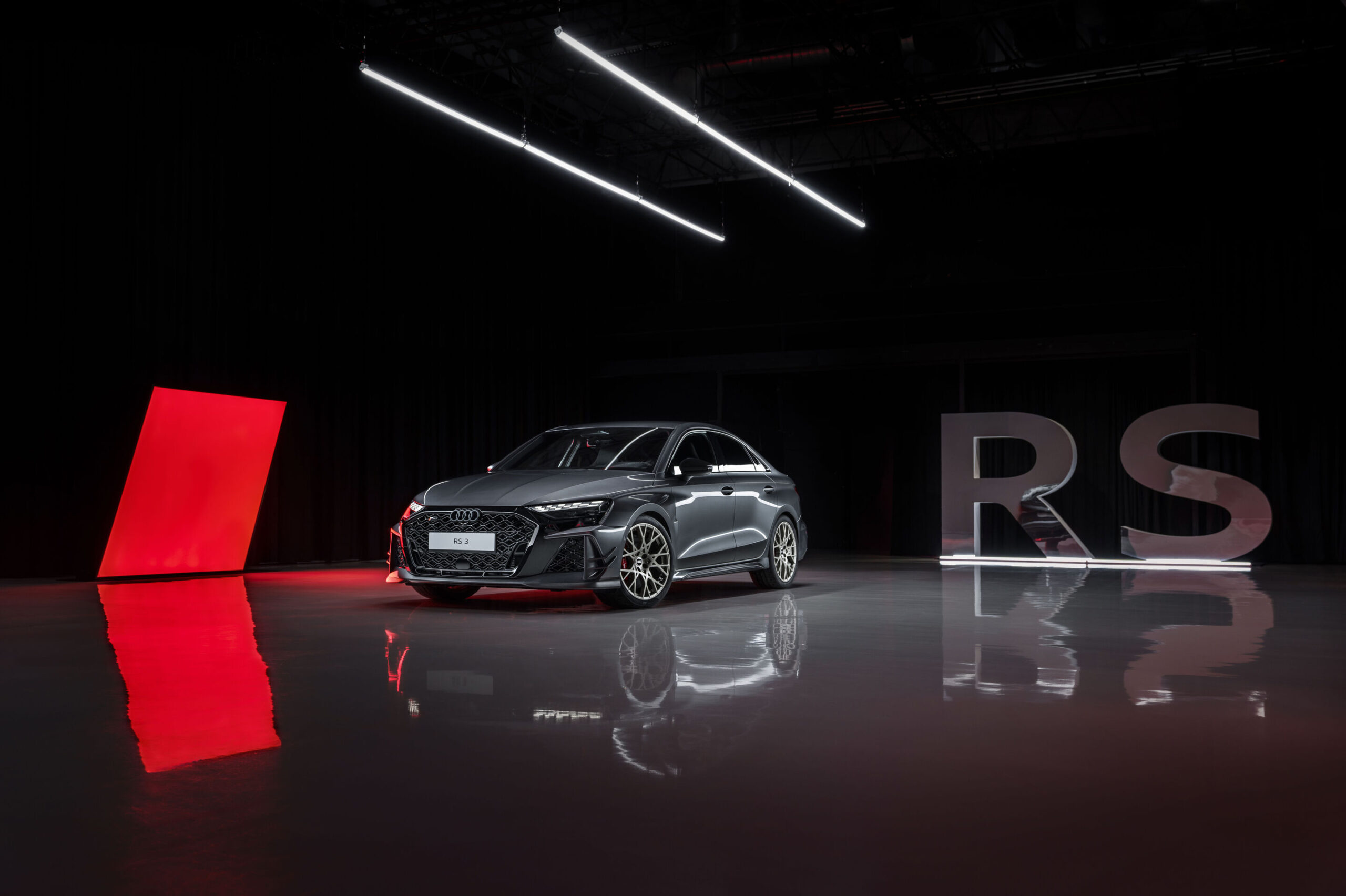
The standard RS 3 is already an aggressive machine. The competition limited takes that aggression and sharpens every edge. The result is a compact saloon or Sportback that looks visually wider, lower, and more purposeful than anything wearing four rings in this size class.
The darkened matrix LED headlights illuminate their segments in a 1-2-4-5-3 sequence when you lock or unlock the car — a direct reference to the five-cylinder’s firing order. It is the most elegant Easter egg in any current production car.
Carbon is applied with surgical intent throughout. Dual stacked canards on each front corner mirror the vertical blades of the air curtains. A split front lip sits below the intakes, visually widening the stance. Mirror caps, side skirts, rear spoiler, the trim above the diffuser — all matte carbon. The result is a car that looks ready to pounce before it’s even started.
Filling those arches are 19-inch ten-spoke wheels finished in Neodymium gold matte — a shade that shouldn’t work as well as it does against carbon and dark bodywork, but absolutely does. The rear side windows carry partial matte film with the model name inscribed, a subtle detail that rewards close inspection.
Three colours are available:
The Malachite green is the one to order. It is an explicit callback to the Audi Sport quattro that launched the brand’s rally dynasty — and on a car celebrating 50 years of the five-cylinder, it is exactly the right choice.
Engine & Performance: The Five-Cylinder at Its Finest
There is no other engine like this in any current compact car. That is not marketing language — it is a simple, verifiable fact. The 2.5-litre turbocharged inline-five is unique to the RS 3 in this segment, and after five decades of development, it has never sounded or performed better than it does here.
The firing order is 1-2-4-5-3 — alternating between adjacent and non-adjacent cylinders. This is what creates that unmistakable burbling, almost chaotic soundtrack that no four-cylinder or six-cylinder can replicate. It is primal and intoxicating, and Audi Sport has worked hard to deliver more of it directly to the cabin. Reduced insulation around the firewall means the sound reaches occupants more immediately, and the RS sports exhaust with fully variable flap control widens the acoustic spectrum depending on the drive select mode.
In RS Performance and RS Torque Rear modes, the exhaust flaps open earlier, delivering the most visceral sound the five-cylinder has ever made in a road car. It is — without exaggeration — one of the greatest engine soundtracks in the current automotive landscape.
The numbers are exceptional for a compact car of this size:
| Engine | 2.5-litre turbocharged inline-five |
| Power output | 294 kW (400 PS / 395 bhp) |
| Torque | 500 Nm |
| 0–100 km/h | 3.8 seconds |
| Top speed | 290 km/h |
| Transmission | 7-speed S tronic dual-clutch |
| Drivetrain | quattro with torque splitter |
| Brakes | Ceramic, red calipers (standard) |
For context: the 1983 Audi Sport quattro — the car that defined the golden age of rallying — produced 225 kW from its 2.1-litre five-cylinder. The RS 3 competition limited produces 294 kW from 2.5 litres. Half a century of progress, distilled into a car you can use daily.
Driving Dynamics: The Coilover Upgrade Changes Everything
The standard RS 3 is already a remarkably capable machine. The competition limited takes the hardware further than any RS 3 before it, and the headline addition is the bespoke coilover suspension — a first for the RS 3 nameplate.
This is not an off-the-shelf coilover kit. It was developed and tuned specifically for this car. Twin-tube shock absorbers use stainless steel at the front and aluminium at the rear for optimal stiffness, with increased volumes to improve hydraulic fluid cooling. The front units feature external reservoirs. The result is consistent damper performance under sustained hard driving — not just on the first corner, but on the twentieth.
The shock absorbers are three-way adjustable, independently. Low-speed compression (12 steps) controls cornering behaviour and tire grip. High-speed compression (15 steps) governs body reaction to sudden impacts and rapid steering inputs. Rebound (16 steps) determines how directly the body follows the road surface. A setup manual and the necessary adjustment tools are included in every car.
The rear stabilizer stiffness of 85 N/mm — paired with rear spring rates increased to 80 N/mm — transforms corner exit behaviour. Combined with the torque splitter’s fully variable rear torque distribution and brake torque vectoring, the RS 3 competition limited rotates into fast corners with a precision that simply was not available in the standard model.
Optional Pirelli PZero Trofeo R semi-slick tires are available for buyers who want to extract the absolute maximum from the chassis. Standard ceramic brakes with red calipers are fitted to every example — lightweight, thermally resistant, and more than capable of matching the performance on offer. New aerodynamic elements at the front and the specific roof spoiler of the Sportback reduce lift at both axles, developed in the wind tunnel exclusively for this edition.
Interior: Gold, Carbon, and a Serial Number
The RS 3 competition limited’s exclusivity does not stop at the door. Open it and the interior announces itself in a colour combination of black, Neodymium gold, and Ginger white — a palette that sounds unusual on paper and looks genuinely striking in person.
Highly contoured RS bucket seats with black leather bolsters and Dinamica microfiber centres in Neodymium gold hold driver and passenger firmly through hard cornering. The door armrests and centre armrest continue the gold theme. Contrast stitching throughout in Ginger white traces a diamond pattern across the seat centres, and the carbon-backed front seats provide a visual reminder of the car’s technical credentials every time a rear passenger looks forward.
Door lighting projects “RS 3 competition limited” lettering on entry. The same script appears on the floor mats, the headrest covers, and the boot carpet. Most significant of all: a matte serial number is engraved in the centre console ahead of the gear selector. Each of the 750 cars knows exactly where it stands in the run — and so will its owner.
The steering wheel is flattened top and bottom in the RS tradition, trimmed in black Dinamica with Ginger white contrast stitching. A Ginger white centring mark at the 12 o’clock position aids precision and visualises steering input during hard driving.
The digital instrument dials feature a white background — a direct homage to the white analogue dials of the 1994 Audi RS 2 Avant, the car that introduced the first RS five-cylinder engine to the road. This is not decoration; it is a considered act of heritage storytelling.
The 10.1-inch RS performance display provides real-time readouts of coolant temperature, torque splitter status, brake temperature, engine and transmission oil temperature, and tire pressure and temperature. Live power and torque output, G-force meters, acceleration data, and a lap timer are also available. When launch control is engaged, starting lights illuminate to indicate the optimal launch moment.
Pros & Cons
Pricing & Availability
€108,365
€110,005
European deliveries begin mid-2026. Both body styles include the full carbon exterior package, Neodymium gold wheels, RS bucket seats, the exclusive digital dials, the coilover suspension, ceramic brakes, RS sport exhaust, and three-zone climate control as standard. A Sonos premium audio system, seat heating, and rear privacy glass are also included. The carbon engine cover atop the five-cylinder is standard too — even under the bonnet, the competition limited refuses to cut corners.
The Audi RS 3 competition limited is not a car for everyone. At over £90,000 in equivalent UK pricing, with only 750 examples available globally, it was never going to be. It is a car for the small number of people who understand what the five-cylinder engine represents, who appreciate why the firing order 1-2-4-5-3 matters, and who want to own a piece of automotive history that will only become more significant with time.
For those people — and you know who you are — this is the finest RS 3 Audi Sport has ever produced. The coilover suspension is a genuine dynamic upgrade. The carbon package is applied with intent, not decoration. The heritage details, from the white instrument dials to the headlight firing order sequence, are the work of engineers who genuinely care about what they’re building. And the five-cylinder itself? After 50 years, it still sounds like nothing else on earth.
Get your order in. Because 750 units will not last long.