Performance Review · 2024 Upgrade · Nürburgring Record Holder
Audi RS 3 Sportback: The Compact That Owns Its Class and Refuses to Apologise
Four hundred horses, a five-cylinder engine unlike anything else on the planet, a Nürburgring lap record that silenced every critic — and it still fits in a supermarket car park. This is the RS 3 Sportback, refreshed and reinvigorated for 2024. And it’s better than ever.
Power Output
Torque
0–100 km/h
Top Speed
Nürburgring Record
Let’s be honest about what the compact performance car segment has become. It’s a furious little arena where engineers and marketers wage simultaneous wars — one for lap times, one for bragging rights. The Mercedes-AMG A 45 S throws 421 hp at the problem. The Honda Civic Type R tears at it with front-wheel-drive purity. The BMW M135 quietly updates itself and hopes nobody notices. And then there’s the Audi RS 3 Sportback — the one that doesn’t need to shout, because it already holds the Nürburgring lap record for compact cars.
Seven minutes, 33 seconds, and 123 milliseconds around 20.832 kilometres of Germany’s most unforgiving racetrack. That number isn’t marketing spin. It’s a fact etched into tarmac, and it says everything about what Audi Sport has built here. But a lap time is only part of the story. Can the RS 3 Sportback be your daily driver, your weekend weapon, and your investment in an engine architecture that simply won’t exist much longer? Read on. We’ve gone deep.
Design: Aggression With Architecture
The 2024 upgrade brings meaningful visual changes, not just a freshened badge. The front end is the most obvious transformation — a new, more expansive single-frame grille flanked by sharper air intakes that actually feed the intercooler, not just look like they do. There’s a sense of visual width here that the pre-facelift car never quite achieved, and the new diffuser at the rear draws a hard line between the RS 3 and the standard A3 range.
The updated matrix LED headlights now illuminate in the sequence 1-2-4-5-3 when locking or unlocking the car — a direct reference to the five-cylinder engine’s firing order. It’s the most elegant automotive Easter egg in any current production car, and it never stops being impressive.
The new motorsport-design wheels are a genuine upgrade over the previous generation’s units — wider, more purposeful, and considerably more interesting to look at. Carbon detailing is applied intelligently rather than gratuitously: the mirror caps, side sill extensions, and the diffuser surround all feature the material, giving the car a credibly purposeful appearance without tipping into costume-drama territory.
RS bucket seats are now standard — no longer an option — and their bolsters and backrest carbon fibre shells are visible from the exterior through the glass. It’s a small thing that adds to the sense that this car is serious hardware wrapped in a sensible package. Four body colours make up the range for the 2024 model:
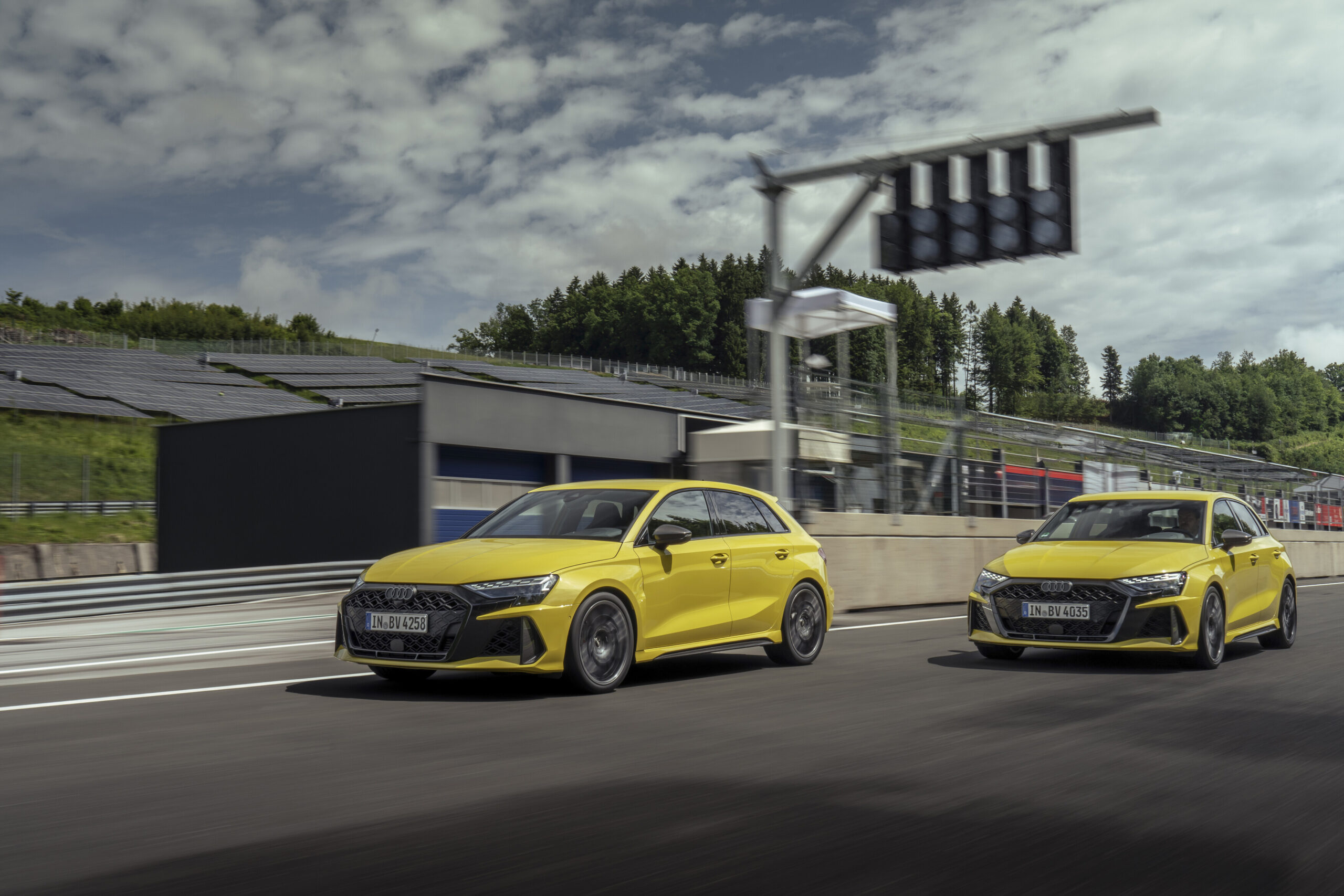
Python Yellow is a new addition, and it divides opinion sharply — which is exactly the point. Against the blacked-out roof rails and dark RS-specific trim, it reads more expensive than it sounds. Kyalami Green, however, is still the colour of choice for those who know their five-cylinder history. It connects the current car directly to the rally-era Audi Sport quattros, and that lineage matters enormously on a car celebrating an engine architecture that has now been in production for half a century.
Engine & Performance: The Last of Its Kind
Let’s state this clearly before diving into numbers: there is no other turbocharged inline-five engine in any current compact production car on the planet. Not one. The 2.5 TFSI in the RS 3 is genuinely unique — a decision by Audi Sport that runs directly counter to the industry’s relentless push toward four-cylinder efficiency, and one that enthusiasts should be deeply grateful for while it lasts.
The firing order — 1-2-4-5-3 — alternates between adjacent and non-adjacent cylinders in a pattern that no four-cylinder or six-cylinder can replicate. The result is a deep, burbling, asymmetric soundtrack that has more character per decibel than arguably anything at this price point. The 2024 upgrade does something clever here: reduced firewall insulation means the sound reaches the cabin more directly, and the fully variable RS sports exhaust amplifies the experience depending on your drive mode. In RS Performance mode, the exhaust flaps open early and the five-cylinder speaks at full volume. It’s spectacular.
On the 2024 Nürburgring record run, the RS 3 Sportback completed the 20.832-kilometre Nordschleife in 7 minutes, 33.123 seconds — more than seven seconds faster than the pre-facelift car, running on the optimised chassis and new tires. That number wasn’t handed to Audi by the weather. They had to earn it.
The engine produces 294 kW — 400 PS and 500 Nm of torque — channelled through a seven-speed S tronic dual-clutch transmission and distributed by the torque splitter quattro system. Unlike traditional quattro systems, the torque splitter can independently apportion drive between the rear wheels, enabling genuine rear-biased dynamics in a way that a conventional front-biased AWD system simply cannot deliver. The numbers on paper are already exceptional for this class:
| Specification | Data |
| Engine | 2.5-litre turbocharged inline-five (TFSI) |
| Power | 294 kW / 400 PS / 395 bhp |
| Torque | 500 Nm (369 lb-ft) |
| 0–100 km/h | 3.8 seconds |
| Top speed | 290 km/h (electronically limited) |
| Transmission | 7-speed S tronic dual-clutch |
| Drivetrain | quattro with rear torque splitter |
| Fuel consumption (WLTP) | 9.5–9.3 l/100 km (combined) |
| CO₂ emissions | 217–211 g/km (WLTP combined) |
| CO₂ class | G |
| Nürburgring Nordschleife lap | 7:33.123 min (class record) |
The torque number — 500 Nm — is where the real-world experience lives. On a dry road in a Sport or RS mode, the mid-range punch between 2,000 and 5,000 rpm is relentless. It doesn’t taper. It doesn’t surge and fade. It simply pulls, constantly and emphatically, until the dual-clutch fires the next gear home with a precision that makes a torque-converter automatic feel lazy by comparison.
Driving Experience: What the Torque Splitter Actually Does
Here’s what separates the RS 3’s driving experience from every front-biased AWD rival in this segment: the torque splitter. In theory, it sounds like a marketing term. In practice, on a damp corner entry, it is a revelation.
Traditional quattro systems push the majority of torque forward under normal conditions, pulling you through corners with the front axle doing the heavy lifting. The torque splitter works differently — it can independently distribute drive between the two rear wheels, which means that under hard cornering the inner rear wheel can be braked while the outer rear wheel receives more torque. The effect is a car that rotates into corners rather than pushing through them. Understeer — the traditional enemy of hot hatchbacks — is effectively neutralised.
In RS Torque Rear mode, the system aggressively redistributes torque to the rear axle and enables the kind of cornering dynamics you’d normally associate with a rear-wheel-drive sports car. The RS 3 Sportback can be steered with the throttle. In a compact hatchback. With all-wheel drive. That is not a normal thing.
The 2024 update also brings revised chassis calibration and new standard tyres, with Pirelli P Zero tyres specifically developed for this model. The steering has been recalibrated for greater precision and less artificial weight, and brake torque vectoring — which individually brakes the inside wheels at corner entry — has been refined to work more transparently with the torque splitter.
On road, the difference is immediately apparent. Turn-in on a fast corner is sharper, the car’s attitude is more adjustable, and the balance point between grip and rotation is more communicative than the pre-facelift car managed. On track — as the Nürburgring time demonstrates — the improvements are even more marked. This is a genuinely driver-focused performance car that happens to also work brilliantly as daily transport.
Drive modes span Comfort, Auto, Dynamic, Individual, RS Performance (maximum combustion performance) and RS Torque Rear (maximum driver engagement). The Comfort mode is genuinely comfortable — a useful reality check on how well-rounded the RS 3 actually is. Most hot hatches feel punishing in their softened modes. The RS 3 doesn’t.
Interior: Sport, Substance, and the Right Priorities
Audi interiors are either your thing or they aren’t, and that reality extends to the RS 3. What you get is a masterclass in ergonomic precision and materials quality — leather, Dinamica alcantara-like fabric, brushed metals, and the kind of switch action that feels engineered rather than assembled. What you don’t get is the emotional theatre of a BMW M or the raw minimalism of a Porsche cabin. The RS 3’s interior is the automotive equivalent of an extremely well-cut suit: formal, precise, quietly impressive.
The 2024 update brings new RS bucket seats standard across the range. They are excellent — highly contoured, genuinely supportive under hard cornering, with enough adjustment range to accommodate a wide variety of driving positions. The flat-bottomed, flat-topped steering wheel sits in front of a 12.3-inch digital instrument cluster that can display RS-specific performance data, navigation, or entertainment depending on your preference.
The 10.1-inch RS performance display in the centre console is the piece of technology that justifies the RS badge from a functionality perspective. Real-time torque splitter status, brake temperature, live G-force, acceleration timing, and lap timer data are all available without requiring any additional subscription. It’s genuinely useful rather than merely impressive.
The 10.1-inch MMI touchscreen handles climate, audio, navigation, and connectivity. It’s responsive, logically organised, and supports wireless Apple CarPlay and Android Auto. The lack of physical controls for climate functions is the only genuine criticism — in cold weather, cycling through menus to adjust temperature is a minor but real irritation. The rest of the interface is excellent.
- 12.3-inch digital instrument cluster with RS performance display options
- 10.1-inch MMI touch display with wireless Apple CarPlay and Android Auto
- RS bucket seats with Dinamica centre sections — standard, not optional
- Flat-top flat-bottom RS steering wheel with shift paddles
- 10.1-inch RS performance display: G-force, torque splitter, brake temp, lap timer
- Audi phone box with wireless charging and signal booster
- Three-zone electronic climate control
- Bang & Olufsen 3D Premium Sound System (optional; genuinely exceptional)
- Sportback-specific boot: 280 litres, 1,100 litres with rear seats folded
Boot space is the Sportback’s ace card over the Sedan variant. 280 litres in standard configuration is adequate for weekend luggage; fold the rear seats and you have a van. The Sportback body style genuinely makes the RS 3 a practical proposition for ownership rather than an occasional-use toy, and that pragmatism matters when the insurance and running costs of a 400 PS compact are already on the spicy side.
Technology & Safety: Assistance Without Interference
The RS 3 runs Audi’s current MIB3 infotainment generation with full connectivity. WLAN hotspot, voice control, Audi connect suite, and over-the-air updates are all standard. The driver assistance suite is comprehensive without being oppressive — a distinction that matters enormously in a performance car where an overly intrusive lane-keep assist or over-sensitive emergency braking system can actively work against the driving experience the car is trying to deliver.
- Adaptive cruise control with stop-and-go functionality
- Lane departure warning (can be fully deactivated for track use)
- Emergency braking with pedestrian and cyclist detection
- Rear cross-traffic alert with intervention
- 360-degree camera system with surroundings view (optional)
- Park assist with front and rear parking sensors
- Speed limit information display integrated into instrument cluster
- Tyre pressure monitoring with real-time temperature readout (via performance display)
- ESC with sport and track modes — fully disengageable
The ESC calibration in Dynamic mode is notably more permissive than in Comfort, allowing a degree of controlled slip that the torque splitter can exploit without triggering an immediate correction. Fully deactivated on a closed circuit, the RS 3 is entirely in the driver’s hands. That’s exactly how it should work.
Competitor Comparison: Who’s Actually in This Fight?
The RS 3 exists in a peculiar position — more expensive than most of its natural rivals, faster than all of them in straight-line and circuit benchmarks, and in possession of an engine architecture that none of them can replicate. Here’s how the key players stack up:
| Car | Audi RS 3 Sportback | Mercedes-AMG A 45 S | BMW M135 xDrive | Honda Civic Type R |
|---|---|---|---|---|
| Engine | 2.5L I5 Turbo | 2.0L I4 Turbo | 2.0L I4 Turbo | 2.0L I4 Turbo |
| Power | 400 PS | 421 PS | 300 PS | 329 PS |
| Torque | 500 Nm | 500 Nm | 400 Nm | 420 Nm |
| 0–100 km/h | 3.8s | 3.9s | 4.9s | 5.4s (FWD) |
| Drive System | quattro (torque splitter) | AMG 4MATIC+ | xDrive AWD | FWD |
| Nürburgring | 7:33.123 ★ Record | 7:44.6 | Not officially set | 7:44.9 (FWD record) |
| Starting Price | ~€67,000+ | ~€72,000+ | ~€55,000+ | ~€46,000+ |
| Engine Character | Unique I5 soundtrack | Flat, surgical | Competent, forgettable | Raw, mechanical |
The Mercedes-AMG A 45 S is the only true direct rival in power terms, and on a racetrack, the RS 3 beats it. The A 45 S is more expensive, slightly more powerful on paper, but less characterful and slower when the stopwatch comes out. The BMW M135 is the practical pragmatist — quicker than the standard competition but positioned below the RS 3 in terms of driver engagement and outright performance. The Honda Civic Type R is a different animal entirely — front-wheel drive, less expensive, and with steering feedback the Audi can’t match, but lacking both the all-weather capability and the straight-line dominance.
“Nothing in this class sounds like it, drives quite like it, or holds the lap record like it. The RS 3 Sportback doesn’t just compete — it establishes the benchmark.”
Nitro Cartel
How It Scores: At a Glance
Pros & Cons
Strengths
Weaknesses
Why You Should Consider It
- You want the fastest compact car on the Nürburgring Nordschleife — and you want that title to mean something when you actually drive it.
- The five-cylinder engine’s soundtrack is not available anywhere else at any price in this class. If that sounds like hyperbole, go listen to one in RS Performance mode with the exhaust open. It isn’t.
- You need a performance car that also functions as a real vehicle — the Sportback’s practicality is genuine, not compromised, and the AWD system means all-season usability without needing a second car.
- You understand that 400 PS through a torque splitter quattro system in a 1,580 kg package is a remarkable engineering achievement for this price point.
- You’re buying one of the last iterations of this engine architecture before electrification makes it impossible — and that has real long-term value.
Why You Might Skip It
- If steering feel and front-end communication are your priorities, the Honda Civic Type R offers a more visceral connection between your hands and the road — at significantly lower cost.
- If you’re primarily track-focused, the AMG A 45 S’s additional 21 PS and four-cylinder efficiency may be more relevant than the RS 3’s warmer, more characterful approach.
- The running costs — insurance, fuel, tyres — are real. This is not a budget-friendly car to own, and if your annual mileage is high, that 9.5 l/100 km combined figure starts to add up.
- If you can wait: Audi Sport is already developing the next-generation RS 3, and the competition limited special edition suggests the current generation is entering its final chapter. A buyer with patience may find better value in 18 months.
Best For: Who Should Buy the RS 3 Sportback?
- The enthusiast who daily-drives hard: Fast enough for weekend track days, practical enough for the school run. The Sportback body style is the right choice for this buyer.
- The engine romantic: Someone who understands what makes a five-cylinder special, who cares about firing orders and exhaust notes, and who will genuinely appreciate owning something that won’t be made much longer.
- The performance pragmatist: quattro all-weather capability, 280+ litre boot, four seats, four doors — this is a sports car argument you can win with a family and a ski trip.
- The occasional track user: The RS Performance display, deactivatable ESC, and torque splitter’s Nürburgring-proven credentials make it a credible track tool without requiring a separate track car.
Pricing & Variants
~€67,000
~€68,000
~€108,000
Pricing varies by market — the figures above are approximate European market starting points. The options list on a well-specced RS 3 can add €10,000–15,000 to the base price, particularly when the Bang & Olufsen audio, ceramic brakes, carbon trim packages, and the optional panoramic roof are factored in. Our recommendation: specify the RS sport exhaust, the ceramic brake package, and the performance display. Skip the panoramic roof if weight is a concern.
The 2024 Audi RS 3 Sportback is the best version of the best compact performance car currently available. That’s a strong statement, and we’re standing by it. The Nürburgring record isn’t marketing theatre — it reflects a car that has been genuinely engineered to be faster, sharper, and more driver-focused than anything that preceded it or currently rivals it in this class.
But the lap time is almost beside the point in day-to-day ownership. What the RS 3 delivers on public roads is something rarer than outright speed: character. The five-cylinder’s soundtrack is irreplaceable, the torque splitter’s ability to rotate the car on corner exit is genuinely thrilling, and the Sportback body style means none of this performance comes at the cost of usefulness.
Is it perfect? No. The steering could be more communicative, the fuel bill will sting if you push it, and a Civic Type R will outpoint it on a tight technical circuit where steering feel wins over traction. But the RS 3 Sportback is not trying to be the Civic Type R. It’s trying to be the definitive compact performance car for someone who needs their vehicle to work every day, perform on weekends, and sound like nothing else on earth doing both. On all three counts, it succeeds completely. Buy one while you still can — this engine’s days are finite, and you will miss it when it’s gone.