World First · Performance PHEV · Audi Sport · 2026
Audi RS 5 Avant Review: 639 Horsepower, Electric Range, and a World-First Drivetrain — The Estate Car That Changes Everything
Audi Sport just built its first-ever high-performance plug-in hybrid. It does nought to 100 in 3.6 seconds, hauls a full boot load of luggage, and can run silently through the city on battery alone. This is not a compromise. This is the future of the RS badge — and it is extraordinary.
PS System Output
Nm Torque
0–100 km/h
EV Range (City)
km/h Top Speed
Introduction: The Estate Car That Has No Business Being This Fast
Let’s be clear about something before we go any further. The Audi RS 5 Avant is, at its core, a station wagon. It has a proper boot. Rear seats that fit adults. A roof rail. It is the kind of car you take to the airport on Sunday morning with two suitcases and a pushchair in the back. And it will hit 100 kilometres per hour in 3.6 seconds. With 639 horsepower. And it can also drive through central London in total silence on battery power alone for more than 80 kilometres. In one car. One price. One key.
This is the new Audi RS 5 Avant — Audi Sport’s first-ever high-performance plug-in hybrid — and it represents one of the most technically ambitious cars the Ingolstadt brand has ever put on public roads. The headline figures are staggering enough. But the real story is under the skin, in the entirely new drivetrain architecture that makes this car a genuine world first. We’re going deep on all of it.
“The A5 model series’ new pinnacle is our first high-performance plug-in hybrid. Our newly developed quattro drivetrain with Dynamic Torque Control is the world’s first electromechanical torque vectoring system in a production car.” — Gernot Döllner, CEO, Audi AG
Design & Exterior: Wider, Meaner, Unmistakably RS
A Body Built Around Performance
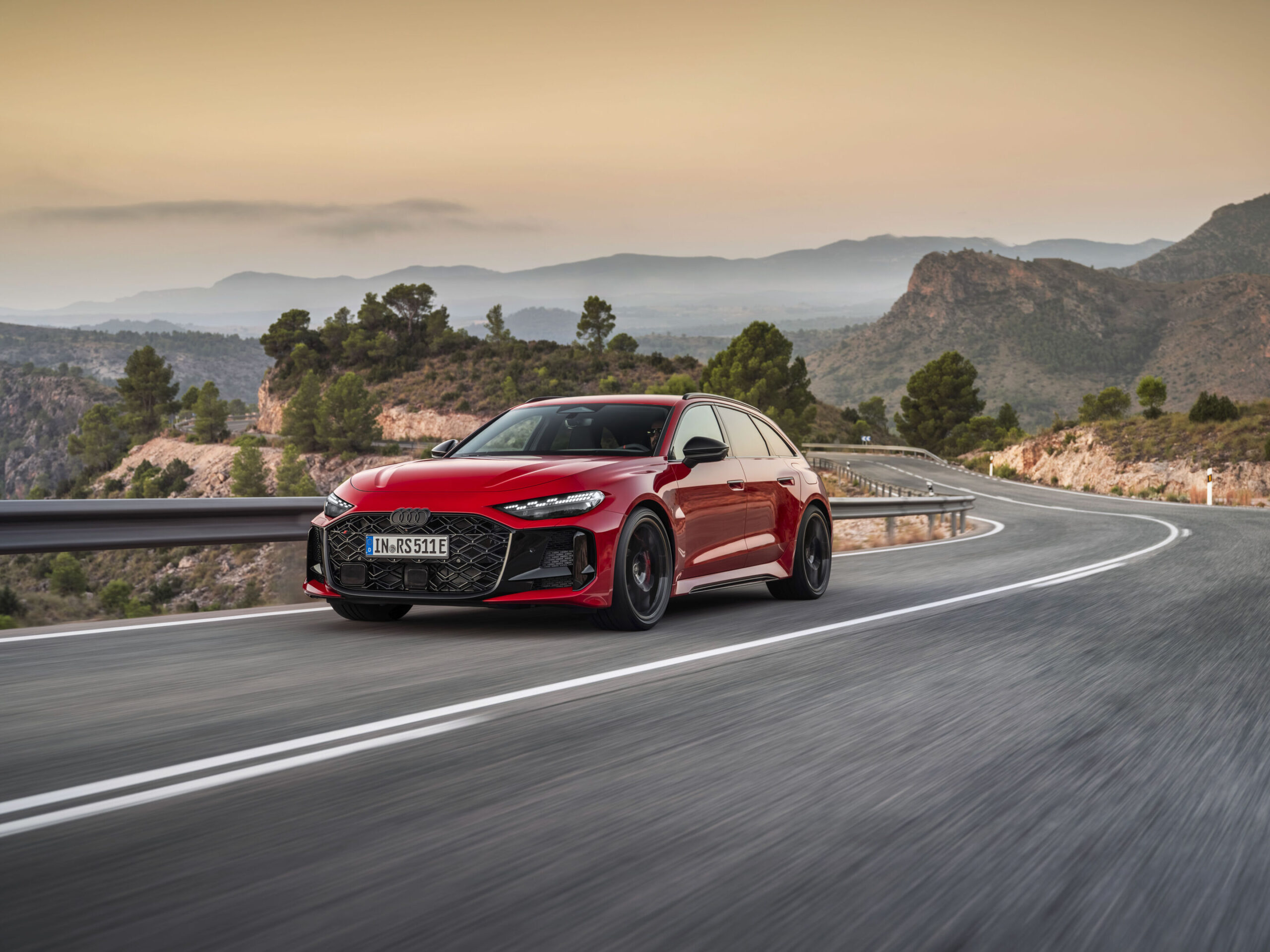
Audi hasn’t just reskinned the A5 Avant and called it an RS. The RS 5 Avant is around nine centimetres wider than the standard A5 at both ends — proper, structural width that comes from genuinely flared wheel arches housing wider tracks, larger wheels, and the significantly expanded rear transaxle housing the new torque vectoring system. Standing next to a standard A5 Avant, the RS feels like it belongs to a different weight class entirely.
The front is anchored by a three-dimensional Singleframe grille with honeycomb mesh. Air curtains integrated into the front corners actively manage airflow around the front wheels, reducing aerodynamic drag at speed rather than simply looking aggressive. The darkened Matrix LED headlights feature a digital daytime-running-light signature in a checkered-flag pattern — a motorsport nod that is subtle for those who don’t know, and immediately meaningful for those who do.
Rear Presence & Aero
Round back, the large functional diffuser and the RS sport exhaust’s matte oval tailpipes in their dedicated black frames create a rear end that communicates intent without resorting to theatre. The optional Audi Sport package adds bespoke dynamic front and rear bumpers that sharpen the silhouette further, plus two-tone diamond-cut phantom black 21-inch wheels with matte accents that are among the best-looking standard fitments on any current performance car.
Carbon camouflage elements are also part of the Sport package, adding visual texture to a car that already has presence in abundance. The standard wheel spec is 20-inch; the Sport package moves to 21-inch. Either fills those arches properly and correctly.
Available Colours
Engine & Powertrain: The World-First Drivetrain That Changes the RS Game
A Hybrid That Actually Makes the Car Faster, Not Just Greener
This is where the RS 5 Avant earns its significance. The powertrain is entirely new — not a carry-over with a battery strapped to it. At the front, an improved 2.9-litre twin-turbo V6 produces 375 kilowatts — that is 510 horsepower — with maximum torque of 600 Newton metres available from 2,000 to 5,000 RPM. That is the combustion engine component alone. In the hybridised eight-speed gearbox sits a 130-kilowatt electric motor. Combined system output: 470 kilowatts, or 639 horsepower. The result of this pairing is a nought to 100 sprint in 3.6 seconds — faster than a Porsche 911 Carrera S. In a car with a roof rail.
quattro with Dynamic Torque Control World First
Here is the real story, and it deserves proper attention. Audi has developed an entirely new rear transaxle for the RS 5. Inside it sits an electromechanical torque vectoring system — the first of its kind in any production car, anywhere, ever. Here is what that means in real terms.
An actuator, overdrive gears, and a purpose-built differential work together to transfer torque between the left and right rear wheels. Not slowly. Not gradually. Every five milliseconds — 200 times per second — a dedicated control unit recalculates the optimal distribution for the current driving situation and executes it immediately. When you’re turning in to a corner, torque moves to the outside rear wheel before you’ve consciously registered that you’re in the corner. When the apex arrives and you get back on the throttle, power goes exactly where grip is available, exactly when it’s needed.
Traditional hydraulic torque vectoring systems react in 100–200 milliseconds. The RS 5’s electromechanical system reacts in 15 milliseconds — roughly a tenth of the blink of an eye. The difference in cornering behaviour is not subtle.
The centre differential also runs with a preload that keeps it partially locked at all times, managing how power splits front to rear before the rear torque vectoring takes over individual wheel delivery. The two systems work together in a hierarchy that gives the RS 5 a driving character completely unlike any previous quattro car. It doesn’t push wide. It rotates. It places itself for the corner exit with the kind of precision you associate with lighter, more focused machines — not a 2,370-kilogram estate car.
Battery, Charging & Electric Capability
The battery in the RS 5 Avant gives a combined electric range of 75 to 83 kilometres on the WLTP cycle, and 81 to 86 kilometres specifically in city driving conditions. Top speed on electric power alone is 140 kilometres per hour, which covers virtually every urban scenario. For a daily driver who charges at home overnight, the RS 5 Avant is genuinely capable of completing a full week of urban driving without touching a petrol station. That is a remarkable transformation for an RS model.
Full Technical Specifications
| Specification | RS 5 Avant |
|---|---|
| Engine | 2.9-litre twin-turbo V6 TFSI |
| Combustion Engine Output | 375 kW (510 PS) @ 6,300–6,800 rpm |
| Electric Motor Output | 130 kW |
| Combined System Output | 470 kW (639 PS) |
| Maximum Torque | 600 Nm @ 2,000–5,000 rpm |
| Transmission | Hybridised 8-speed automatic |
| Drivetrain | quattro with Dynamic Torque Control (electromechanical torque vectoring, world first) |
| 0–100 km/h | 3.6 seconds |
| Top Speed (Sport Package) | 285 km/h (optional) |
| Electric Top Speed | 140 km/h |
| Electric Range, City (EAER) | 81–86 km |
| Electric Range, Combined (EAER) | 75–83 km |
| Fuel Consumption (weighted WLTP) | 4.4–3.9 l/100 km |
| Fuel Consumption (battery flat) | 10.1–9.6 l/100 km |
| CO² Emissions (weighted) | 100–88 g/km (Class C–B) |
| Unladen Weight | 2,370 kg |
| Body Width vs. Standard A5 | +9 cm at both axles |
| Wheel Options | 20-inch (standard) / 21-inch (Sport package) |
| Brakes | Steel (standard) or RS Ceramic with bronze calipers (Sport package) |
Driving Dynamics: Composure, Precision, and Controlled Drama
The RS sport suspension uses twin-valve shock absorbers — a technology that allows each damper to simultaneously deliver both a compliant ride and aggressive body control. The twin-valve design enables the shock absorbers to respond differently to low-frequency road undulations and high-frequency impacts within the same unit, eliminating the traditional trade-off between comfort and sportiness. Pitch and roll are measurably reduced. Audi’s engineers tested this on the Circuit de Marrakech and on the winding mountain roads of the Atlas Mountains, and the feedback from the first drive was unambiguous: the RS 5 rotates into corners with a willingness that belies both its weight and its estate body.
The RS-tuned steering has been specifically calibrated for the wider track and electromechanical torque vectoring system. The result is a car where the front end communicates what’s happening at the tyres without filtering it out, and where mid-corner corrections feel precise and confidence-inspiring rather than approximate.
Journalists who drove the RS 5 Avant in Morocco reported initiating controlled drifts purely through steering angle — without lifting off or applying additional throttle. In a 2,370 kg estate car. That is the electromechanical torque vectoring system working as designed, and it is a genuinely remarkable thing to experience.
The optional Audi Sport package adds RS ceramic brakes with bronze-coloured calipers — lighter than steel, far more resistant to thermal fade under repeated hard stops, and the correct choice for anyone planning any track activity. The standard steel brakes are more than adequate for road use.
Interior & Technology: A Cockpit Worth the Price Tag
Driver-Focused Without Ignoring the Passengers
The RS 5 Avant’s interior is unmistakably RS in character: dark, premium, driver-orientated without being austere. The centre of the dashboard is anchored by a 14.5-inch MMI touch display running Audi’s most current software platform. Haptic feedback is precise and satisfying; the menu architecture makes sense after minimal familiarisation. This is a touchscreen experience that has been genuinely thought through by people who use touchscreens, not one bolted in as a specification tick.
The RS-specific virtual cockpit presents all performance data clearly in the instrument cluster. Power output, torque, G-forces, acceleration data, temperatures for coolant, transmission, engine oil, and brakes are all accessible. In RS Torque Rear mode, the drift angle statistics are logged and displayed. Read that sentence again if you need to. Audi built an estate car that records your drift angles and presents them as data for later review. This is exactly the right approach to performance car technology.
The Audi Driving Experience Function
Standard on every RS 5 Avant, this system enables detailed route and lap analysis displayed on the 14.5-inch MMI screen. Sector times at the racetrack are logged and stored. Performance driving data is presented in a format that is genuinely useful for development and improvement rather than being a gimmick that’s impressive for five minutes and then forgotten.
Interior Exclusivity & Sport Package Highlights
The optional Audi Sport package transforms the cabin with contrast stitching in Serpentine green and brass — a combination that photographs unusually well and looks genuinely striking in person. It is the first time Audi Sport has used brass as a contrast colour in an RS interior, and it works. The exterior carbon camouflage elements from the same package carry through the visual language established by the bronze ceramic brake calipers visible through the wheels, creating a coherence across exterior and interior that demonstrates considered design rather than option-list assembly.
Practicality & Real-World Use: An Estate Car That Earns Its Keep
For all its technical ambition, the RS 5 Avant does not forget what an Avant is supposed to be. The boot remains genuinely practical despite the PHEV architecture. Audi have packaged the battery and motor integration in a way that does not materially intrude into cargo capacity — this is still a car you can load for a proper holiday, not a compromised half-measure. The rear seats accommodate adults with dignity. Three-zone climate control is standard. Long-distance comfort is supported by a comprehensive driver assistance suite for motorway running that takes the fatigue out of the kilometres without removing the driver from the equation.
Charging is straightforward for anyone with a home wallbox. The battery tops up overnight as part of the routine, and city driving then happens entirely on electric power — silently, cheaply, with zero emissions locally. For the buyer who charges regularly, the weighted WLTP combined consumption of 4.4 to 3.9 litres per 100 kilometres is not a theoretical fiction but a genuinely reachable real-world figure. For the buyer who never charges, the RS 5 Avant carries around a significant battery for no benefit and returns 10.1 to 9.6 litres per 100 kilometres on the V6 alone. The efficiency story is conditional on charging habits. This is not a criticism unique to the RS 5 — it is the honest reality of all PHEVs — but it is worth stating clearly.
How It Stacks Up: RS 5 Avant vs. The Competition
The RS 5 Avant exists in a segment where the competition is serious and well-established. The BMW M5 Touring, Mercedes-AMG E63 S Estate, and Porsche Panamera Sport Turismo are its natural rivals. Here is how the data compares.
| Model | Power | 0–100 | EV Range | Weight | Approx. Price |
|---|---|---|---|---|---|
| Audi RS 5 Avant ★ | 639 PS (PHEV) | 3.6s | 75–83 km | 2,370 kg | €107,850 |
| BMW M5 Touring (PHEV) | 727 PS | 3.5s | ~67 km | 2,440 kg | €145,000+ |
| Mercedes-AMG E63 S Estate | 612 PS | 3.5s | None | 2,045 kg | €155,000+ |
| Porsche Panamera ST 4S E-Hybrid | 544 PS | 3.7s | ~50 km | 2,320 kg | €160,000+ |
The RS 5 Avant is the most affordable entry in this segment by a significant margin and offers the longest electric range of any direct competitor. The BMW M5 Touring edges it on raw power and matches it on sprint time, but at a significantly higher price and with a slightly smaller EV range. The AMG E63 remains a pure combustion enthusiast car — brilliant in its own right, but without the daily-driver efficiency of the RS 5 system. The Panamera Sport Turismo is more expensive with less power and a smaller battery. On paper, the RS 5 Avant’s value proposition in this segment is almost uncomfortably strong.
Pros & Cons
Why You Should Consider It
You want the fastest estate car experience available at a price that doesn’t require selling a property to justify. You want technology that is genuinely leading-edge — not just in marketing language but in engineering reality, with a world-first torque vectoring system that changes how a car this size handles corners. You charge at home, which means the PHEV system works exactly as intended for your daily routine. You have a family or a lifestyle that demands space, but you’ve never been willing to accept that practicality and driving pleasure are mutually exclusive. You want an Avant — because deep down you know the estate is always the right answer — and you want the best one ever made.
Why You Might Skip It
You don’t have home charging and do significant motorway mileage, which means the PHEV premium delivers little real-world benefit. You want something lighter and more focused — a dedicated sports car rather than an all-rounder — and the weight of the RS 5’s PHEV system feels like a compromise rather than a benefit. You’re emotionally attached to the previous RS 5’s combustion-only character and aren’t ready to reframe what an RS car can be. Or your budget is significantly below the 107,000-euro entry point, in which case the standard Audi S5 Avant is a genuinely excellent car at a considerably lower price.
Best For
Pricing & Availability
€106,200
€107,850
Both models are built at Audi’s Neckarsulm plant in Germany. Order books for European buyers opened in Q1 2026 with deliveries expected from Summer 2026. The optional Audi Sport package is available for both body styles and adds significant exterior, interior, and performance upgrades including the 285 km/h top speed, RS ceramic brakes with bronze calipers, and Bedford green metallic paint.
The Audi RS 5 Avant is not just the best RS 5 ever built. It is one of the most technically significant performance cars of its generation. The electromechanical torque vectoring system at the rear axle is a world first that genuinely transforms how a car this large and this heavy corners — not marginally, but fundamentally. The PHEV architecture adds meaningful real-world capability without diluting the RS character. The estate body remains genuinely practical despite carrying an electric motor, a battery, and a completely new rear transaxle that hasn’t existed in any production car before this one.
Yes, it is heavy. Yes, it is expensive. Yes, the efficiency story requires a charging habit to deliver its full promise. None of these are small caveats. But in a segment where compromises are the norm, the RS 5 Avant makes fewer than any of its competitors while offering more of what actually matters: driving precision, real-world usability, and the kind of engineering ambition that makes a car feel worth owning long after the new-car smell has faded.
If you’re in the market for a fast estate and you can live with the price, the RS 5 Avant is the answer. Not one of the answers. The answer. Order it in Bedford green with the Sport package. You won’t regret it.