World First · Performance Hybrid · Electromechanical Torque Vectoring
The New Audi RS 5: A Performance Hybrid That Actually Changes Everything
Forget what you think you know about hybrid performance cars. The new Audi RS 5 pairs plug-in electrification with a world-first electromechanical torque vectoring system at the rear axle — and the result may be the most dynamically capable RS car Audi has ever built for the road.
Torque Shift
Nm Differential
Actuator Output
Actuator Torque
System Voltage
There’s a moment on a fast, technical corner — one that demands everything from the car and everything from the driver — when you either trust the machine, or you don’t. The best performance cars make that trust effortless. They are not just fast. They are intelligent. And the new Audi RS 5 is built, from the ground up, to be exactly that.
Released in March 2026, the new RS 5 represents more than an evolution of Audi’s high-performance coupe and Avant lineup. It is the debut of quattro with Dynamic Torque Control — a world-first in any production car. For the first time, electromechanical torque vectoring is deployed at a rear transaxle, shifting up to 2,000 Nm of differential torque between the rear wheels in just 15 milliseconds. That is roughly a tenth of a human blink.
The premise is audacious. The execution, by all technical accounts, is extraordinary. Here’s our deep-dive into why the new Audi RS 5 might just be the most technically significant performance hybrid of 2026.
The World First: quattro with Dynamic Torque Control
No production car before the RS 5 has deployed electromechanical torque vectoring in a rear transaxle. This is not marketing language. It is a genuine engineering first — and it changes what a performance hybrid drivetrain can do.
To understand why this matters, you need to understand what conventional torque vectoring systems can’t do. Clutch-based torque splitters — the kind found in most performance AWD systems — distribute torque only when there is positive drivetrain load. Lift off the throttle, and the system loses authority. This limits what’s achievable under trail braking, mid-corner corrections, or any moment when the driver is off the gas.
Audi’s electromechanical system has no such limitation. Because the 400-volt permanent-magnet electric motor actuator is fixed to the rear transaxle — connected via spur and planetary gears to both the left driveshaft and the differential carrier — it can generate and distribute torque differences regardless of whether the driver is accelerating, coasting, or braking. The system operates continuously in all conditions. That is the breakthrough.
In practical terms: where a traditional torque splitter goes quiet when you lift off mid-corner, quattro with Dynamic Torque Control remains fully active, stabilising the car precisely when it needs it most. It is the difference between a reactive system and a genuinely anticipatory one.
How the System Works — Step by Step
The high-voltage actuator (8 kW, 40 Nm) generates additional torque at the rear. The overdrive gears take this actuator torque and use it to vary the power flow within the transaxle, routing torque differences to whichever rear wheel needs it. The conventional differential with low lock percentage then distributes this to the right and left driveshafts as required.
The result: up to 2,000 Nm of torque differential can be transferred to either rear wheel within 15 milliseconds — continuously, in both directions, independent of how much drive torque the combustion engine is delivering. The actuator is positioned on the left side of the vehicle; when torque needs to reach the right driveshaft, it travels via the differential carrier. This architecture ensures precise, high-speed adjustment dynamics in every corner scenario.
Design: Performance Architecture, Inside and Out
The new RS 5 does not wear its technology ostentatiously. The exterior follows the evolutionary design language Audi has refined across its current RS lineup — wide, purposeful, and visually planted — but the real design story is what’s underneath. Every functional element has been positioned with the quattro Dynamic Torque Control system in mind.
The rear transaxle packaging required Audi’s engineers to re-engineer the rear axle entirely. This is not a carry-over component with an electric motor bolted on. It is a brand-new design, built around the high-voltage actuator, overdrive gears, and differential as an integrated unit. The water-cooling circuit for the permanent-magnet motor is part of the vehicle’s broader thermal management architecture — a reflection of how seriously Audi has approached the performance hybrid brief.
Functional elements are placed for optimal performance to ensure the precise interaction of all system components. This is Audi’s stated design philosophy for the RS 5 — and unlike similar claims from many manufacturers, it is backed by genuinely novel engineering.
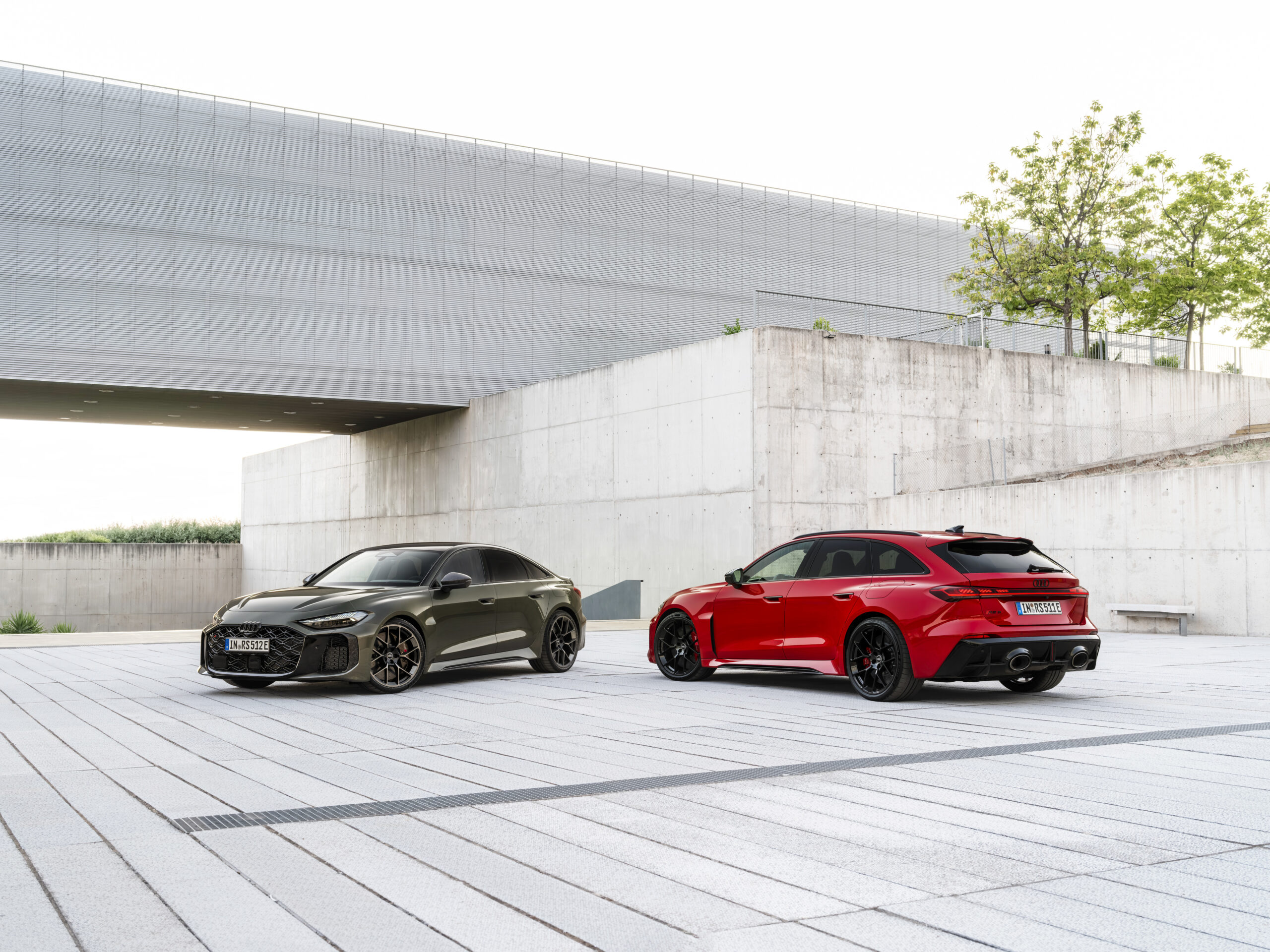
The available body styles — Sedan and Avant — retain the RS 5’s broad-shouldered proportions, low roofline, and wide rear haunches. The Avant, in particular, remains one of the most handsome load-carrying performance cars on sale anywhere. It is the shape that reminds you why Audi’s designers still lead the segment for integrated, purposeful aesthetics.
Performance & Driving Dynamics: On a New Level
Audi uses the phrase “handling on a new level” for the RS 5 with Dynamic Torque Control — and while that language appears in press materials, the technical substance behind it is hard to argue with. The system’s real advantage emerges in three distinct driving scenarios.
Cornering Performance
When cornering, electromechanical torque vectoring shifts torque to the rear wheel with the greatest grip. This is standard torque vectoring behaviour — but the RS 5’s version does it continuously, with higher resolution, and without the dead zone that clutch-based systems exhibit off-throttle. The car maximises traction at the wheel that can use it, throughout the entire corner, not just on the way out.
Balance and Controllability
The system’s second mode of operation is balancing. Here, torque differences are used to influence the car’s yaw behaviour — actively managing whether the front or rear of the car is being asked to do more work. The chosen Audi drive select mode determines the character. In comfort-oriented modes, the system favours neutral, predictable responses. In performance modes, it biases toward rear-wheel loading, creating a more mobile, agile rear end. The driver always maintains control; the system simply makes that control easier to access.
Stability at the Limit
The third and most impressive scenario is limit stabilisation. If the RS 5 becomes unstable — if a corner tightens unexpectedly, or if the driver enters too fast — quattro with Dynamic Torque Control reduces the yaw rate, slowing the turn-in to give the driver time to respond with steering, braking, or throttle inputs. This is a safety system executed at supercar bandwidth. 15 milliseconds of reaction time versus the 150–250 milliseconds a skilled human driver requires to perceive and react.
The HCP1 High-Performance Computing Platform is the central intelligence of the RS 5’s drivetrain and suspension. It compares vehicle condition with environmental data and driver inputs simultaneously — and critically, it interprets intent from steering inputs, distinguishing between a driver correcting oversteer (requiring rapid response) and a driver initiating a corner entry (requiring smooth torque build). Steering input reaches the wheels instantly and unfiltered.
Integration with the Full Chassis System
Electromechanical torque vectoring does not operate in isolation. At the rear axle, it manages torque distribution. The electronic differential lock and brake torque vectoring primarily support the front axle, increasing traction where the rear system cannot reach. The twin-valve shock absorbers at all four corners are precisely calibrated to work with the torque vectoring system — particularly during the transition from high-speed straight-line running to turn-in, where the combined response creates what Audi describes as “extremely fast throttle response.” In practice, this means the car feels alive at the point of corner entry, rather than the slight lag that affects less integrated systems.
System Performance at a Glance
Engine & Hybrid Architecture: The Performance PHEV Brief
The RS 5 is powered by what Audi calls a “modular high-performance plug-in hybrid system.” Specific combined power outputs for the production model have not been published at the time of writing, but the key technical architecture is clear: the combustion engine at the front works in concert with the electric motor actuator at the rear transaxle — a layout that separates the two power sources onto different axles and creates genuine, independently managed all-wheel drive performance.
The hybrid architecture is not a fuel economy measure wearing a performance badge. The 400-volt electric system is integral to the car’s dynamic behaviour. The permanent-magnet electric motor at the rear does not simply supplement combustion power — it actively manages torque distribution at the rear axle, making it a chassis component as much as a powertrain one.
| Specification | Detail |
| Drivetrain Architecture | Modular High-Performance Plug-In Hybrid |
| Rear System | Brand-new rear transaxle with electromechanical torque vectoring |
| Electric Actuator Motor | Water-cooled permanent-magnet, 400V |
| Actuator Output | 8 kW / 40 Nm |
| Torque Vectoring Type | Electromechanical (world-first in production car) |
| Max Torque Differential | Up to 2,000 Nm between rear wheels |
| Torque Shift Response | 15 milliseconds |
| Key Gear Components | Overdrive gears + conventional differential (low lock %) |
| Off-Throttle Operation | Full authority — unlike clutch-based torque splitters |
| Braking Operation | Full authority under braking |
| Drive Select Modes | From neutral/balanced to rear-biased/highly agile |
| Central Control | HCP1 High-Performance Computing Platform |
| Fuel Consumption (RS 5 Sedan, combined weighted) | 3.8–4.3 l/100 km |
| CO2 Emissions (RS 5 Sedan, weighted combined) | 86–98 g/km |
| CO2 Class (weighted combined) | B–C |
| Available Bodies | Sedan / Avant |
On a discharged battery, the RS 5 Sedan returns 9.5–10.0 l/100 km — comparable to traditional performance cars without the hybrid benefit. With a charged battery, the efficiency advantage is significant, with CO2 emissions in the B–C class range. For a car at this performance level, those numbers are genuinely impressive.
Interior & Technology: Intelligence Where It Counts
The RS 5’s interior reflects Audi’s current design maturity — understated where it matters, sophisticated throughout. The RS-specific instrumentation and drive select interface give the driver full visibility into what the quattro Dynamic Torque Control system is doing in real time. Live torque distribution, drive mode status, and chassis performance data are available through the driver’s display — a level of transparency that performance buyers will appreciate.
The wide spectrum of Audi drive select modes is central to the RS 5 experience. From neutral and balanced everyday settings to rear-biased, highly agile configurations, each mode meaningfully changes how the torque vectoring system behaves — not just how the exhaust sounds or how the throttle responds, but how the car rotates, where it places its weight, and how directly it reacts to steering inputs. This is genuine mode differentiation, not marketing segmentation.
The HCP1 interprets steering input in context: it distinguishes between a rapid correction (likely oversteer management) and a deliberate turn-in (corner initiation). This intent recognition allows the system to prepare its torque response before the driver’s input fully registers — making the RS 5 feel more intuitive than any purely reactive system can achieve.
Steering input is described by Audi as “instantaneous and unfiltered” — meaning the delay between wheel movement and front axle response is minimised as much as current technology allows. Combined with the rear torque vectoring’s immediate availability, this creates a coherent, communicative driving experience that bridges the gap between sports car feel and everyday usability.
Real-Time Torque Display
Multi-Mode Drive Select
Twin-Valve Shock Absorbers
Brake Torque Vectoring
Electronic Diff Lock
400V Thermal Management
Intent-Aware Steering
The Driving Experience: What Does It Actually Feel Like?
This is the question that matters. Technical specifications are compelling, but a car is ultimately judged by what the driver feels through the seat, the wheel, and the pedals.
According to Audi’s own description — based on the system’s engineering brief — the RS 5 executes commands “almost instantaneously and with high precision.” Drivers maintain maximum control over the vehicle’s movements with handling that is “more direct and predictable — even at the limits of dynamic driving.” The word that keeps appearing in Audi’s own technical language is predictable. Not docile. Not suppressed. Predictable — which, for a driver, is the highest possible compliment. A predictable car is one you can exploit confidently.
The electromechanical torque vectoring increases what Audi calls “control and manageability,” and the character of that control shifts with the drive mode. In comfort-oriented settings, the car manages its own behaviour and corrects imbalances before the driver notices them. In performance settings, the system’s intervention is more transparent — the driver can feel the car loading the outer rear wheel through a fast corner, can sense the yaw being managed precisely at the limit, and can use that information to place the car more accurately.
Electromechanical torque vectoring is at its best during sporty driving — braking late, turning in, getting back on the gas just after the apex. This is the sequence the system was designed for, and it is where the 15-millisecond response time makes the biggest difference to driver confidence and car balance.
There is also the PHEV dimension. Unlike conventional performance cars, the RS 5 can arrive at a corner with the electric actuator pre-conditioned — the rear torque vectoring system is not waking up from cold; it is already active, already monitoring, already ready. The combustion engine’s output is augmented and managed by the hybrid system to deliver consistent performance regardless of state of charge.
How It Compares: RS 5 vs. The Segment’s Best
The new Audi RS 5 enters a fiercely contested performance coupe and Avant segment. The BMW M3/M3 Touring, Mercedes-AMG C 63, and Porsche Panamera PHEV each have something compelling to offer. Here’s how the RS 5 stacks up on the technologies that matter most.
| Feature | Audi RS 5 | BMW M3 xDrive | AMG C 63 S E | Porsche Panamera 4 E |
| Torque Vectoring Type | Electromechanical (World First) | Clutch-based rear TV | Clutch-based rear TV | Torque Vectoring Plus |
| Off-Throttle TV Authority | Full — all conditions | Limited off-throttle | Limited off-throttle | Partial off-throttle |
| PHEV Powertrain | Yes — high performance | No (mild hybrid only) | Yes — 4-cylinder PHEV | Yes — V6/V8 PHEV |
| CO2 Class | B–C (weighted) | D–E | B–C (weighted) | B–C (weighted) |
| Avant/Touring Body | Yes (Avant) | Yes (Touring) | No | Estate only |
| Central Chassis Computer | HCP1 (fully integrated) | Integrated control | AMG DYNAMICS | PDK/PDCC integration |
| Unique Segment Technology | Electromechanical TV (world first) | M xDrive AWD | 4-cyl PHEV AMG | Porsche heritage |
The RS 5’s competitive edge is its torque vectoring architecture. No rival in the segment offers the same off-throttle and braking authority in a production car. The AMG C 63 S E Performance makes a bold PHEV case with its four-cylinder turbocharged engine, but faces ongoing buyer scepticism around the powertrain. The BMW M3 Touring remains the emotional rival for Avant buyers, but its AWD torque vectoring lacks the resolution Audi’s electromechanical system offers. The Panamera is in a different class entirely — larger, more expensive, and more GT-focused.
Pros & Cons: The Honest Assessment
Why You Should Consider It
- You want the most technically advanced torque vectoring system available in any production car — and you want it in a practical Sedan or Avant body.
- You drive quickly on real roads, where off-throttle and braking stability actually matters and clutch-based systems leave gaps.
- Company car tax, CO2 taxation, or BEV infrastructure limitations make a high-performance PHEV the rational choice in your market.
- You appreciate engineering innovation and want a car that represents a genuine step forward — not just a refresh of existing RS hardware.
- The Avant body is essential — because the BMW M3 Touring remains the only rival, and the RS 5’s torque vectoring architecture gives it a dynamic advantage.
Why You Might Skip It
- You primarily track your car and want the lightest possible setup — the PHEV architecture adds weight that dedicated track tools avoid.
- You never charge your car and live in a region without CO2 tax benefits — the PHEV proposition weakens significantly if you run on a flat battery regularly.
- You prefer a more analogue, pure-combustion character and are wary of electric motor intervention in the driving experience.
- You want confirmed power figures before committing — Audi has not yet published combined output numbers for the RS 5 hybrid system.
- Budget is a concern — Panamera-adjacent pricing means the RS 5 competes against some very serious alternatives for the money.
Best For: Who Should Buy the New RS 5?
The automotive industry has spent a decade asking whether electrification and driving dynamics can genuinely coexist. The new Audi RS 5 gives the clearest answer yet: not only can they coexist, electrification can make a high-performance car more dynamically capable than any purely combustion system could achieve.
quattro with Dynamic Torque Control is not a marketing name for an existing technology applied in a new way. It is a world-first engineering achievement — the first time electromechanical torque vectoring has appeared in a production car’s rear transaxle. The 15-millisecond response time, the full off-throttle and braking authority, the HCP1’s intent recognition from steering inputs — these are not incremental improvements. They represent a step change in what a performance car chassis can do in real-world driving conditions.
The question marks are real. Power figures remain unpublished. The PHEV weight penalty is a factor for track-focused buyers. And the CO2 benefit disappears quickly if you don’t charge the car regularly. These are valid reservations that will determine whether the RS 5 is the right car for any individual buyer.
But for the driver who buys the new RS 5 — who actually charges it, who actually uses the drive select modes, who actually explores what electromechanical torque vectoring feels like at the limit of a fast corner on a challenging road — this is likely to be one of the most rewarding performance cars of 2026. Audi has built the RS 5 that the technology always promised but could never previously deliver. That is worth paying attention to.