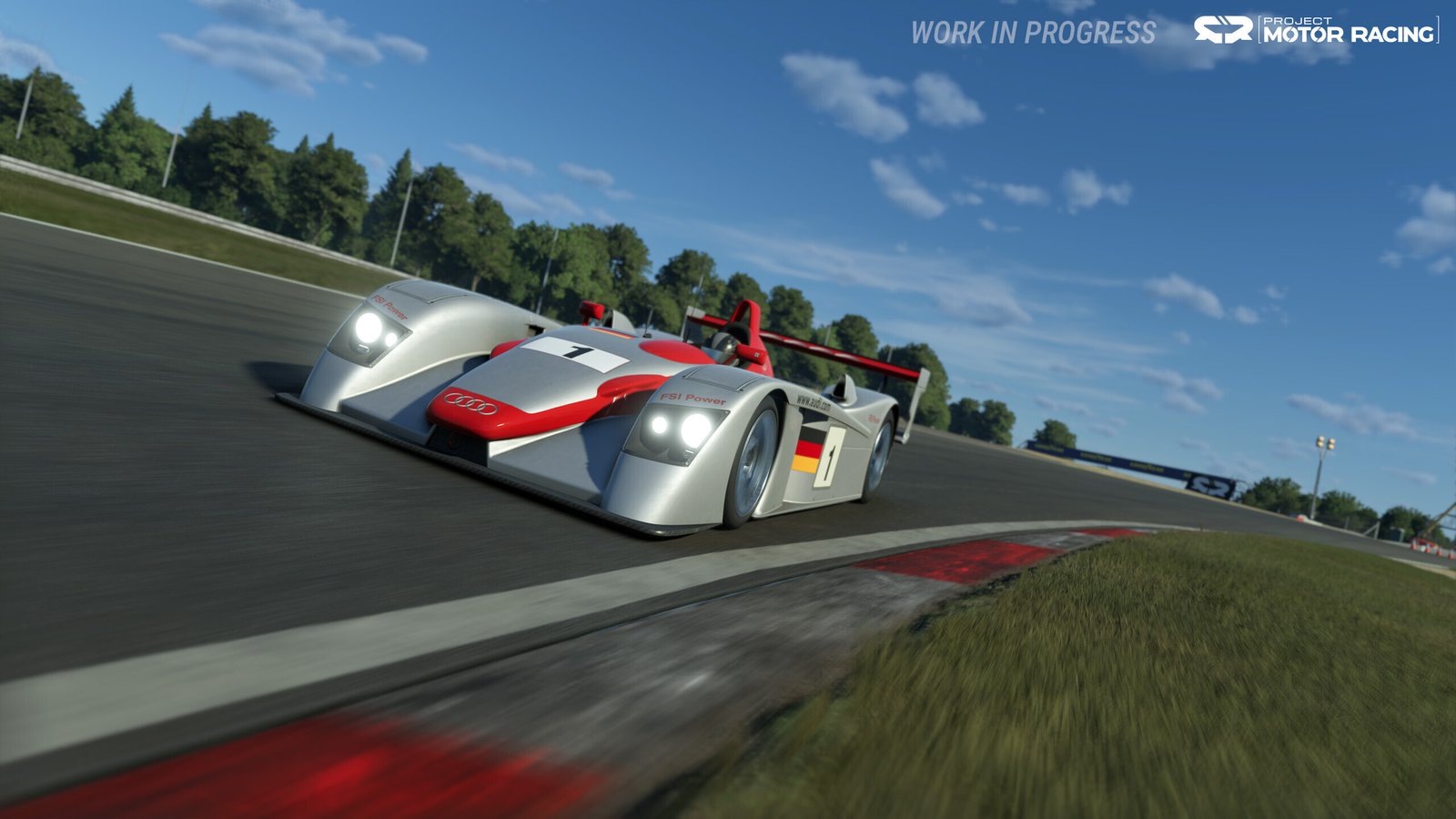
THE LEGEND RETURNS: AUDI R8 LMP
HITS GAMESCOM
Long before the hybrid hypercars, the original Audi R8 Prototype ruled Le Mans with an iron fist. Now, the exact chassis that secured the legendary 2002 hat-trick is dropping jaws at gamescom—and bridging the gap between analog history and digital simulation.
Analog Violence in a Digital World
At gamescom in Cologne, amidst the glowing screens, RGB keyboards, and high-fidelity VR headsets, sits a piece of absolute analog violence: the 2002 Le Mans-winning Audi R8 Prototype. With its battle scars, track grime, and 610-horsepower V8, it stands as a stark reminder of an era where motorsport was won with massive mechanical grip and sheer driver endurance.
Audi Tradition didn’t just bring the car to the world’s largest gaming convention as a static museum piece. They brought it to celebrate its digital resurrection in GIANTS Software’s upcoming racing simulation, Project Motor Racing. It’s a masterstroke of marketing, bridging the visceral reality of early 2000s endurance racing with modern sim-racing culture.
– Kai Mensing, Licensing at Audi Tradition
The Machine: A Dynasty of Dominance
To understand why the R8 LMP is revered, you must look at its brutal efficiency. After a 3rd and 4th place finish in its 1999 debut, the R8 returned to the Circuit de la Sarthe to sweep the podium entirely in 2000. It won again in 2001. By June 16, 2002, the trio of Frank Biela, Tom Kristensen, and Emanuele Pirro drove this exact chassis to secure a historic hat-trick—a feat managed by only a handful of manufacturers in the century-long history of the race.
Under the carbon fiber skin lies a 3.6-liter V8 FSI engine. In 2002, FSI (Fuel Stratified Injection) was revolutionary. It allowed the R8 to extract maximum power (610 PS and over 700 Nm of torque) while severely cutting fuel consumption. At Le Mans, where races are won in the pits, the R8’s ability to run longer stints than its rivals was its deadliest weapon. Paired with a chassis that weighed a mere 900 kg, it was an unstoppable force.
The Digital Translation: Project Motor Racing
Driving an LMP car in the real world is reserved for a handful of elite athletes. But starting November 25, 2025, Project Motor Racing (developed by Straight4 Studios) will hand the keys to the gaming community. According to Kai Mensing, the simulation has reached a level of fidelity where “you almost forget you’re playing a video game.”
For sim-racers, this means grappling with the massive downforce and terrifying lack of modern driver aids that defined the early 2000s prototype era. At the gamescom booth, GIANTS Software is actively challenging attendees to set the fastest lap time in the simulation right next to the physical car—a brilliant juxtaposition of history and interactive technology.
Historical Context
| Le Mans Year | Audi Vehicle | Key Achievement | Drivers |
|---|---|---|---|
| 1999 | Audi R8R | 3rd & 4th Place (Debut) | Pirro/Biela/Theys |
| 2000 | Audi R8 | Historic 1-2-3 Podium Sweep | Biela/Kristensen/Pirro |
| 2001 | Audi R8 | Title Defense (1st & 2nd) | Biela/Kristensen/Pirro |
| 2002 | Audi R8 (Display Car) | The Hat-Trick Podium Sweep | Biela/Kristensen/Pirro |
Pros & Cons of Sim-Racing Integration
The Good
- Preserves the legacy of historically significant vehicles for a new generation of enthusiasts.
- Allows fans to experience the raw handling characteristics of non-hybrid prototypes.
- The physical display at gamescom is presented in its authentic, race-worn condition (complete with dirt and scuffs).
The Challenges
- No simulation can perfectly replicate the physical g-forces and thermal exhaustion of a 24-hour race.
- Highly accurate physics engines in games like Project Motor Racing can be brutally punishing for casual players.
Enthusiast’s Guide
Why You Should Care
The R8 LMP represents the peak of early-2000s motorsport. Before the massive hybrid systems and silent EV drives took over Le Mans, races were won with screaming V8s and bulletproof reliability. The R8 is the undisputed king of that era.
Where to See It
If you’re at gamescom in Cologne (August 20-24, 2025), head to Hall 6, Stand B061. If you miss the convention, the physical car is part of Audi Tradition’s historic collection, and a special Le Mans exhibition runs in Zwickau until November 2025.
Where to Drive It
You can pilot the 2002 Le Mans-winning chassis digitally when publisher GIANTS Software launches Project Motor Racing on November 25, 2025. Be prepared for a steep learning curve.
Technical Specs Snapshot
Nitro Cartel Final Verdict
Bringing a 2002 Le Mans-winning prototype, complete with its authentic track grime, to a modern video game convention is a stroke of genius by Audi Tradition. The R8 LMP isn’t just a car; it’s the foundation of a modern motorsport dynasty. By integrating its raw 610-horsepower V8 physics into Project Motor Racing, Audi ensures that the brutal, analog legacy of early 2000s endurance racing isn’t locked away in a museum, but actively experienced by a new generation of digital drivers.
A TRUE ICON
About the Luxury Performance Landscape
The technology forged at Le Mans with the R8 LMP—specifically FSI fuel injection—eventually trickled down to power the legendary modern performance machines we revere today, from the road-going audi r8 to the devastatingly fast audi rs6 and audi rs 5. Even if you’re walking into an audi dealership near me to check an audi q3 price or configure an audi q5, that race-winning DNA is part of the brand’s heritage.
Today, as the automotive world shifts toward the audi electric car and the expanding audi ev lineup (including the audi etron and audi q8 etron), looking back at these pure combustion legends provides critical context. Whether you are cross-shopping luxury car brands like maseratis and maybachs, dreaming of the top most expensive car in the world like a rolls royce phantom, or browsing affordable luxury cars and used luxury cars, the shadow cast by the original R8 prototype is massive and undeniable.