First Drive · March 2026
🇲🇦 Marrakesh & Atlas Mountains
We Drove the 2026 Audi RS5 in Morocco — Here’s the Truth
Track, mountain passes, and ancient city streets. Audi took the new RS5 PHEV to one of the most demanding environments on earth — and it didn’t flinch once. This is our unfiltered verdict from the road.
System PS
Nm Torque
0–100 km/h
EV Range
km/h Top Speed
There’s a moment — somewhere between the drift zones of the Circuit de Marrakech and a switchback mountain pass in the Atlas — where the new Audi RS5 makes everything click. The 2.9-litre twin-turbo V6 is building torque, the electric motor is filling every gap in the power curve, and the electromechanical torque vectoring is imperceptibly shifting force between the rear wheels. The car is rotating. You’re in control. And somewhere in the back of your mind, a voice says: this doesn’t feel like a 2,355-kilogram hybrid.
That is the magic trick Morocco reveals about the new Audi RS5 PHEV. It’s the car that genuinely shouldn’t be this good. The performance numbers are impressive enough on a spec sheet — 470 kW, 825 Nm, 3.6 seconds, up to 84 kilometres of all-electric range. But numbers don’t tell you what it feels like to push an Audi RS5 Sportback through a high-altitude Atlas Mountain pass or throw it sideways in a designated drift zone for the first time. We went to Morocco to find that out.
Rolf Michl, Managing Director of Audi Sport: “The new RS 5 is setting new standards in technology and demonstrating the potential of its plug-in hybrid drive. Our electromechanical torque vectoring at the rear axle, together with the RS sport suspension, use that weight smartly. The result is a new RS 5 that drives with more precision and stability but still feels agile and light on its feet.”
That claim — agile and light on its feet — is either marketing hyperbole or an engineering achievement. In Marrakesh, we found out which.
On the Circuit de Marrakech: Where It Earns Its Red Rhombus
The Circuit de Marrakech isn’t a place that forgives softness. It was configured for the RS5 press launch with tight curves, technical slalom sections, and — most provocatively — designated drift zones where Audi handed journalists access to RS Torque Rear mode for the very first time.
Off the starting line, the RS5’s response to steering inputs is the first thing that surprises. For a car this heavy, the front end follows driver intent with an immediacy that the previous generation simply couldn’t match. You can feel the center differential’s preload working — keeping the front and rear axles coupled even when you lift throttle before a turn, preventing that nose-heavy, understeering behaviour that plagues heavier performance cars.
At corner exit, the system calculates and distributes optimal torque between the rear wheels every 5 milliseconds — at 200 Hz — reacting 15 milliseconds faster than any driver could consciously perceive. The result: the RS5 accelerates out of corners with a rotation and traction combination that feels effortless.
The torque vectoring becomes most viscerally apparent on fast exit. In RS Sport mode, the rear end loads up and pushes the car forward with purpose, the outer rear wheel receiving the torque concentration needed to rotate and accelerate simultaneously. It’s a sensation closer to a rear-wheel-drive sports car than anything in this category has delivered before. This isn’t marketing language — it’s a genuinely perceptible, qualitative improvement over the previous quattro setup.
The drift zones are where the RS5 shows its most playful face. In RS Torque Rear mode — debuting for the first time on the RS5 nameplate — a deliberately high proportion of torque goes to the outside rear wheel. The stability envelope is wide but defined. The car rotates controllably. Sustained slides are possible and manageable. And critically, when you gather it up, the torque vectoring normalises the situation almost instantly. It is, in the truest sense, a performance tool that rewards commitment without punishing honest mistakes.
“The 2026 Audi RS5 on a circuit is nothing like the car you’d expect from reading its weight figure. The torque vectoring transforms the physics. You stop thinking in kilograms and start thinking in exit speeds.”
— Nitro Cartel, Circuit de Marrakech, March 2026
From Racetrack to Atlas Mountains: The Real-World Test
Track performance, in isolation, proves only so much. The more revealing drive begins when the RS5 leaves the circuit and heads into the Atlas Mountains on roads that the Moroccan road surface has not been kind to. Sun-baked tarmac. Crumbling edges. Hairpins with no run-off. Switchbacks tight enough that a transit van would slow to a crawl. This is where a car’s engineering coherence is either confirmed or exposed.
Barren valleys, snow-capped peaks, switchback roads snaking into high altitude — the Atlas passes present surface irregularities, rapid changes of gradient, and road widths that demand both suspension sophistication and driver confidence. Not a test any previous RS5 could have passed with this score.
The twin-valve shock absorbers show their full range here in a way that no circuit can demonstrate. On lower-lying mountain roads with broken surfaces, the absorbers genuinely cushion — the car rides over imperfections with a compliance that you wouldn’t expect from a machine tuned to this level of circuit precision. Push higher into the Atlas, where the road tightens and the pace increases, and the dampers instantly firm their response, reducing body roll and pitch to an almost imperceptible level through steep rocky channels.
This is the point of twin-valve technology: compression and rebound are controlled independently. You don’t have to choose between a comfortable touring ride and a precise sports car chassis. You get both, in the same car, simultaneously. Previous generations of the RS5 made you trade one for the other. This generation refuses to.
Through mountain villages, the RS5 glides almost silently in all-electric mode. The absence of the V6 doesn’t diminish the car — it changes its character. The instant torque from the electric motor gives smooth, responsive progress through the narrow streets. When the road opens up and demands more, the combustion engine joins forces and the combined 825 Nm pushes the car up switchbacks with effortless authority.
Steering precision is maintained throughout. The 13:1 ratio that felt so immediate on the circuit translates to confidence on the mountain passes, where precise placement through tight hairpins is not optional. On one particular ridge section — where boulders narrowed the road to single-file width — the RS5’s steering delivered the kind of absolute accuracy that turns potential anxiety into calm control.
Full Specifications: The Numbers Behind the Performance
| Powertrain Type | Plug-in Hybrid (PHEV) |
| Combustion Engine | 2.9L Twin-Turbo V6 TFSI — 375 kW (510 PS) |
| Electric Motor | 130 kW (177 PS) / 460 Nm |
| Combined System Output | 470 kW (639 PS) / 825 Nm |
| 0–100 km/h | 3.6 seconds |
| Top Speed (standard) | 250 km/h |
| Top Speed (Sport Package) | 285 km/h |
| EV Range (EAER) | 84 km / 87 km city |
| Battery Capacity | 25.9 kWh gross / 22 kWh net |
| AC Charging | 11 kW (100% in 2.5 hours) |
| Transmission | 8-Speed Tiptronic |
| Drivetrain | quattro with Dynamic Torque Control (world-first eMTV) |
| Steering Ratio | 13:1 (RS-tuned) |
| Suspension | 5-link front & rear, twin-valve RS sport dampers |
| Standard Brakes | 420/400mm steel, iBRS brake-by-wire |
| Optional Brakes | 440/410mm ceramic — stops from 100 km/h in 30.6m |
| Kerb Weight — Sedan | 2,355 kg |
| Kerb Weight — Avant | 2,370 kg |
| Sedan Price (Germany) | €106,200 |
| Avant Price (Germany) | €107,850 |
| Production | Neckarsulm, Germany |
Performance at a Glance
Five Driving Modes, One Radical Range
What makes the RS5’s flexibility genuinely impressive is how wide the range actually is. We experienced all five modes in Morocco — from gliding silently through Marrakesh’s old city streets in Comfort to drifting on the circuit in RS Torque Rear. Here’s what each delivers:
Comfort
Full EV, hushed, soft suspension. Ideal for the medina and urban streets.
Balanced
EV-capable, neutral handling. Daily motorway and mountain touring.
Dynamic
Rear-biased quattro. Sharper steering. Reduced yaw damping. Lively but secure.
RS Sport
Maximum lateral acceleration. Battery held at 90%+. Track-grade traction at all times.
RS Torque Rear
Drift-biased. Massive outer-rear torque. Circuit-only. Lap time and drift angle logging included.
In Morocco, the transition between Comfort and RS Sport was one of the most dramatic character shifts we’ve experienced in any road car. The same vehicle that drifted silently through an Atlas mountain village minutes earlier was drifting sideways through the circuit drift zone. The range is genuinely, remarkably wide.
How It Looks in the Moroccan Light
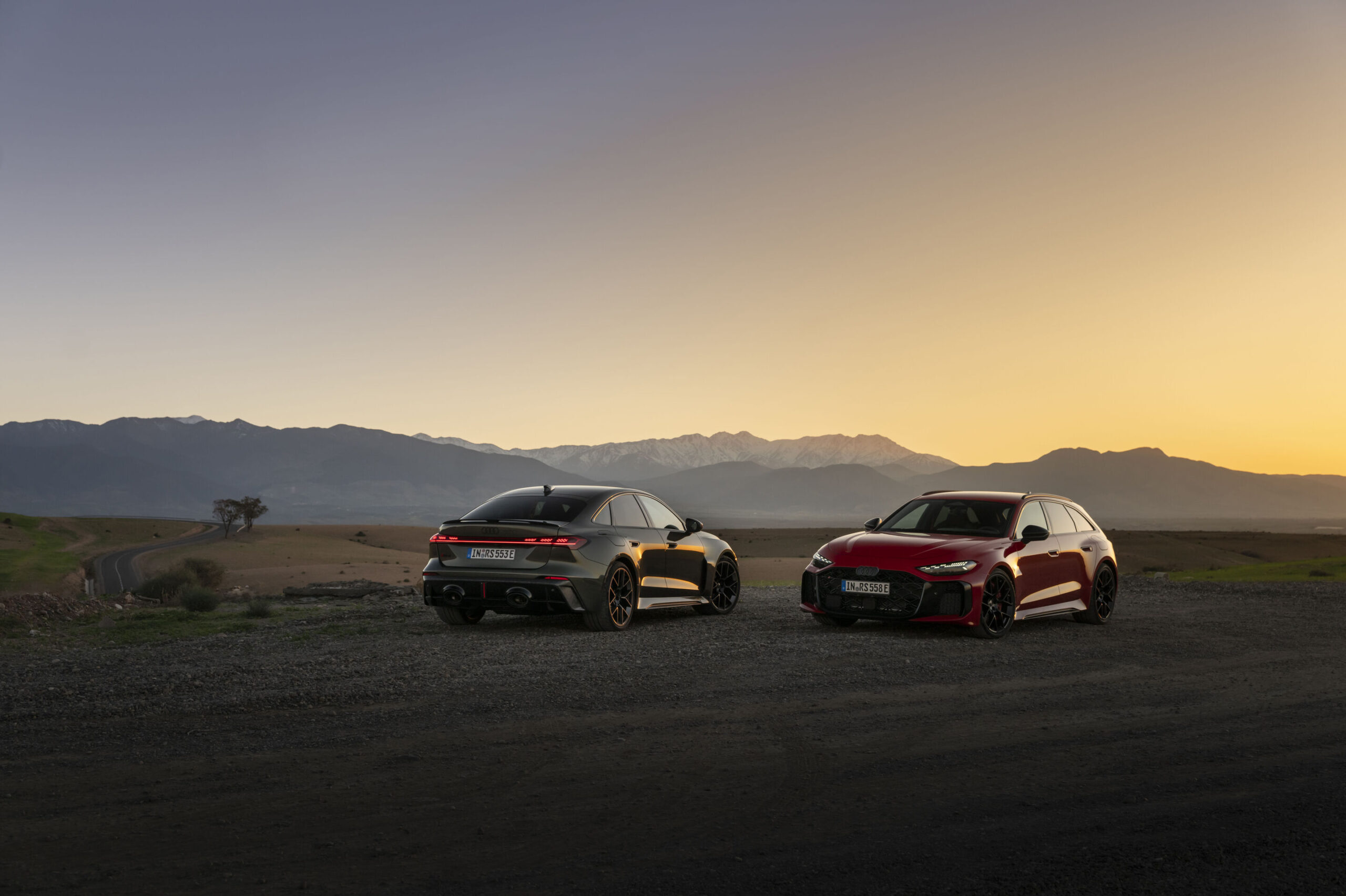
Car design is context-dependent, and Morocco is extraordinary context. Against the red clay walls of Marrakesh’s medina, the RS5’s muscular proportions — four centimetres wider than the A5 at each corner, with flared fenders referencing the legendary Ur-Quattro — are immediately striking. The three-dimensional honeycomb Singleframe grille catches the late-afternoon Atlas light. The broad shoulders create visual mass that the flared arches justify completely.
The darkened Matrix LED headlights and the digital daytime running light in a checkered-flag signature are more noticeable in real Moroccan sun than in any studio photograph. The car looks purposeful and premium without being ostentatious — a difficult balance that Audi has achieved by keeping the design taut and letting the proportions do the talking.
The interplay of light and shade across the RS5’s broad shoulders and flared fenders is at its most vivid in strong sunlight. The Atlas Mountains provide the most beautiful backdrop any press car has had this year. In person, the new RS5 is a more handsome machine than press photography suggests.
The RS sport exhaust’s matte oval tailpipes and the rear diffuser with vertical fins give the rear end a functional purposefulness that feels earned rather than styled-on. The central red reflector in the diffuser — a motorsport heritage nod — is the kind of detail you only notice up close, but appreciate immediately when you do.
Three Technologies That Define This Car
Electromechanical Torque Vectoring
A world first in a production car. 200 Hz control frequency. 15ms response time. Up to 2,000 Nm torque differential between rear wheels. Bidirectional. Active under braking, acceleration, and coasting. Changes what’s physically possible from a front-engined AWD car.
Twin-Valve Shock Absorbers
Independent compression and rebound control. Reduces pitch and roll to near-zero in dynamic modes. Provides genuine compliance on rough mountain roads in comfort modes. The reason the RS5 can be both: track tool and touring car. Tested on hydropulse rigs at beyond-road-going forces.
PHEV Energy Management
Two operating modes: EV and Hybrid. Digital slider for preferred state of charge. Predictive routing optimises when to use electric power. RS Sport and RS Torque Rear hold battery at 90%+ for full electric support. Boost function available even in full-EV driving.
How the RS5 Compares: The Competitor Reality Check
The new Audi RS5 price starts at €106,200 in Germany — placing it in a highly contested bracket. Here’s how it stacks up against the segment’s key rivals on the metrics that matter most from a Morocco-informed perspective:
| Model | System Power | 0–100 | EV Range | Torque Vectoring | Est. Price |
|---|---|---|---|---|---|
| Audi RS5 PHEV 2026 Tested | 639 PS | 3.6s | 84 km | eMTV (World-First) | €106,200+ |
| BMW M5 (G90) PHEV | 727 PS | 3.5s | ~67 km | xDrive (no vectoring) | €139,900+ |
| Mercedes-AMG C63 S E Performance | 680 PS | 3.4s | ~13 km | AMG Performance 4WD | €98,500+ |
| Porsche Panamera 4 E-Hybrid | 544 PS | 3.7s | ~90 km | Torque Vectoring Plus | €115,000+ |
| Alfa Romeo Giulia Quadrifoglio | 510 PS | 3.9s | None | None (RWD only) | ~€95,000 |
The AMG C63’s EV range is effectively useless for real-world electric commuting. The M5 has more power but costs significantly more and lacks rear electromechanical torque vectoring. The Porsche Panamera matches EV credentials but is a larger, more luxury-focused proposition at higher price. On Morocco’s evidence, the RS5 occupies a uniquely coherent position in the matrix: powerful enough, efficient enough, and more dynamically sophisticated than anything else at this price point.
Honest Assessment: Pros & Cons
Should You Buy One?
✓ Why You Should Consider It
If your week involves a mix of city commuting, motorway miles, and weekend driving events — the RS5’s range of capability is extraordinary. The Morocco first drive confirmed that the EV mode is genuinely usable for short-range urban driving, while RS Sport and RS Torque Rear modes deliver circuit-credible performance. For buyers in markets with PHEV tax benefits, the efficiency credentials create a strong financial case alongside the performance numbers. If you want the most technologically advanced quattro drivetrain ever fitted to a production car, there is no other choice. The world-first torque vectoring system alone makes this car historically significant. The Audi RS5 Avant variant adds estate practicality that makes the package even more complete for real-world buyers.
✗ Why You Might Skip It
If combustion purity matters most to you — if you want an engine note uncomplicated by electric motor intervention, a chassis weight that genuine sports cars achieve — the Alfa Romeo Giulia Quadrifoglio remains the segment’s emotional choice, at lower cost. If maximum straight-line performance is the priority and budget is secondary, the BMW M5 has more power. If you need DC fast charging for long-distance electric travel, the RS5’s AC-only setup is a meaningful limitation. And if the Audi RS5 price at this trim level exceeds your budget, there are strong used Audi RS5 examples from the 2019–2023 generation available that deliver most of the experience at considerably lower outlay.
Best For: Who Should Buy the 2026 Audi RS5?
🌏 The Mixed-Use Performance Driver
Silent EV commuting on weekdays, full-fat RS Sport mode on weekends. No other car in this class does both with this level of competence. Morocco proved it beyond doubt.
🏁 The Track Day Enthusiast
RS Torque Rear drift mode, Audi driving experience sector times, and world-class torque vectoring make this a credible circuit tool that can be driven home afterwards in Comfort mode.
👥 The Performance Family Buyer
Particularly as the RS5 Avant (Sportback). Estate practicality, four proper seats, and enough performance to dispatch most dedicated sports cars. A masterclass in all-round ability.
🏭 The Executive Driver
Sophisticated interior, advanced OLED MMI, genuine fuel economy when driven sensibly, and strong residual values. The car that impresses in both the boardroom car park and on an Alpine pass.
Audi CEO Gernot Döllner said it best in Morocco: “Driving here — with sun, dust, and challenging mountain roads — shows just how confidently and reliably our first high-performance plug-in hybrid handles real-world conditions. This is what Vorsprung durch Technik is all about: true innovation proves itself not on a test rig but out on roads around the world.”
He’s right. The new Audi RS5 proves itself in Morocco in a way that a press conference or a spec sheet never could. On the Circuit de Marrakech’s drift zones, the torque vectoring delivers exactly what Audi claims: a fundamentally more capable, more playful, more composed RS model than anything that wore the badge before. On the Atlas Mountain switchbacks, the twin-valve suspension confirms that this car genuinely has no dynamic weakness. In the old city streets, the EV mode demonstrates that 84 kilometres of electric range isn’t just a number — it’s a real-world behaviour change.
The Audi RS5 PHEV is the most complete, most versatile, most technically sophisticated RS5 ever made. Whether you’re searching for an Audi RS5 for sale at the top of the market, considering the RS5 Sportback for daily practicality, or evaluating the Audi RS5 Avant as the ultimate performance estate — the 2026 generation earns a decisive recommendation. Morocco settled the argument. This car is the real thing.
| Performance 9.5/10 |
Handling 9/10 |
Technology 9.5/10 |
EV Usability 8.5/10 |
Interior 9/10 |
Value 8/10 |
Overall 9.1/10 |