The Audi RS5
Just Changed Everything
639 PS. 84 km on pure electricity. A world-first quattro drivetrain. The RS5 isn’t just a new car — it’s a new category.
The Hybrid That
Dares to Be an RS
For years, “hybrid” was a dirty word at Audi Sport. Not anymore. The all-new 2026 Audi RS5 just proved that electrification and flat-out performance aren’t mutually exclusive — they’re a marriage made in Ingolstadt heaven.
Let’s be blunt: there’s been a creeping anxiety in the performance car world. Electrification is coming, the argument goes, and it’s going to sanitize the sports cars we love. Remove the theatrics. Disconnect driver from machine. The Audi RS5 — the latest generation — has arrived as Audi Sport’s loudest possible rebuttal to that fear.
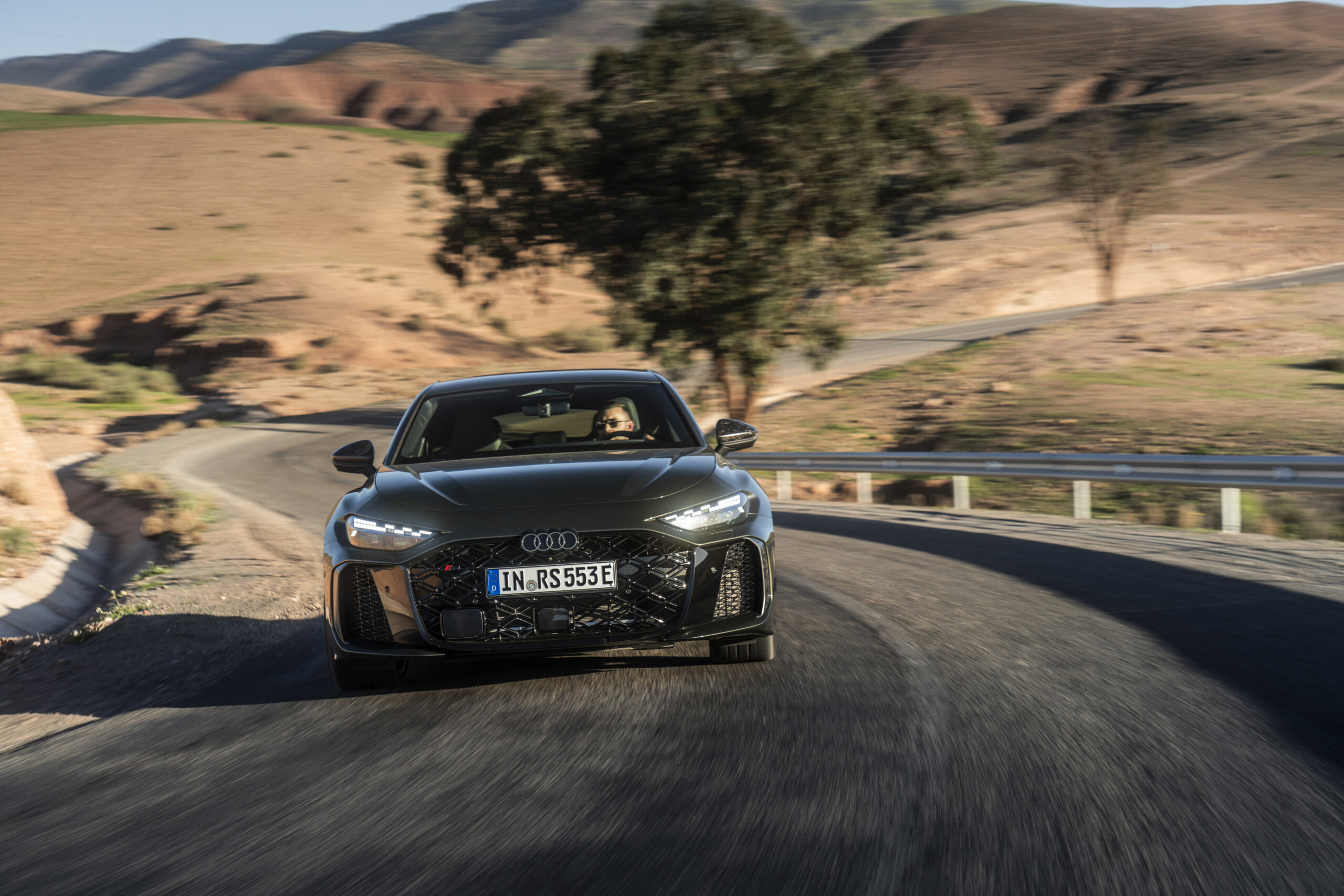
This isn’t the Audi RS5 of old, slavishly following the template of a naturally aspirated howler. This is something genuinely new: a 470 kW (639 PS) plug-in hybrid performance sedan and estate that does 0–100 km/h in 3.6 seconds, covers up to 84 km on electric power alone in the city, and features a world-first electromechanical torque vectoring system that Audi is calling quattro with Dynamic Torque Control. If that sounds ambitious, it’s because it is. And remarkably, it delivers.
“The RS 5 and its innovative drive concept mark the beginning of a new era for our RS models.”
— Rolf Michl, Managing Director, Audi Sport
The new Audi RS5 is available as the RS5 Sedan (what some markets call the RS5 Sportback or fastback silhouette) and the RS5 Avant wagon. German pricing kicks off at €106,200 for the Sedan and €107,850 for the Avant, with European deliveries expected from Summer 2026. Build it loaded with the Sport package and ceramic brakes and you’ll be brushing €130,000 — which puts it firmly in the crosshairs of some formidable rivals.
But here’s the thing: nothing in the premium performance segment does exactly what the new RS5 does. And that matters.
Numbers That
Don’t Lie
* Fuel consumption (weighted, combined): 4.3–4.4 l/100 km. CO₂ emissions (weighted, combined): 86–100 g/km. On discharged battery: 9.5–10.1 l/100 km. Data refer to German market specification.
The Engine That
Got Smarter
Two power sources. One devastatingly cohesive powertrain. This is how you build a hybrid that doesn’t feel like a compromise.
The heart of the 2026 Audi RS5 is a heavily revised 2.9-litre biturbo V6 — itself a legend in the performance world — but now producing 375 kW (510 PS), up 44 kW on the previous generation. That’s not a minor upgrade; that’s a genuine step change. Audi achieved it through a modified Miller cycle, which closes intake valves earlier for improved partial-load efficiency, paired with new variable-geometry turbochargers, optimised high-pressure injection, and — for the first time on an RS5 — water-to-air intercoolers. The result is an engine that’s simultaneously more powerful, more efficient, and more responsive.
Layered on top of the V6 is a purpose-built 130 kW (177 PS) electric motor integrated directly into the hybridised eight-speed tiptronic gearbox. Its external-rotor design — meaning the stator sits inside the moving rotor — enables a larger contact area between components, generating 460 Nm of torque with superior thermal management. This isn’t a belt-integrated starter-generator arrangement; this is a proper, parallel-hybrid architecture where both sources contribute meaningfully.
The combined system output — 470 kW and 825 Nm — is delivered through Audi’s new eight-speed tiptronic, itself revised to reduce drivetrain inertia and sharpen shift times. The gearbox features an external cooler to maintain performance under sustained high-load conditions, and the electronic shift logic adapts dynamically to whichever drive mode is selected.
At the touch of a steering wheel button, the RS5 deploys maximum combined power for 10 seconds — the perfect tool for a motorway overtake or a track sector. The gearbox instantly selects the ideal gear, and if you’re in EV mode, the V6 fires instantly and opens the exhaust valves for full auditory drama.
On a real road, that 3.6-second 0–100 figure feels entirely credible. The combination of instant electric torque fill-in with the V6’s mid-range surge creates a genuinely special sensation — like the car is constantly loading and then releasing potential energy. There’s no lag, no hunt, no hesitation. Just relentless, layered acceleration.
Under high load, Audi claims the RS5’s revised V6 uses up to 20 percent less fuel than its predecessor. With the battery charged, you’re looking at as little as 3.8 litres per 100 km on the combined WLTP cycle — a number that would have seemed fantastical for a 639 PS machine five years ago.
A World First That
Actually Matters
Every manufacturer talks about torque vectoring. Audi just reinvented it at the molecular level.
The headline innovation in the 2026 Audi RS5 isn’t the hybrid powertrain — it’s what sits at the back. The new rear transaxle houses an electromechanical torque vectoring unit that constitutes a genuine world first in production vehicles. And unlike so many “world firsts” that exist primarily for press releases, this one has tangible, perceivable consequences for how the car drives.
Here’s how it works: a water-cooled permanent-magnet electric motor producing 8 kW and 40 Nm acts as the actuator. It drives overdrive gears that can redirect torque — variably and bidirectionally — between the rear wheels through a conventional differential. A central driving dynamics controller (HCP1) runs this system at 200 Hz — meaning it recalculates and adjusts torque distribution every 5 milliseconds. It can deploy torque differences of up to 2,000 Nm between the rear wheels in just 15 milliseconds.
Center Differential with Preload
Always at least partially locked — supports turn-in and eliminates internal understeer, especially when lifting off throttle mid-corner.
Bidirectional Torque Transfer
Unlike mechanical systems, the electromechanical unit can push torque in either direction — effective under acceleration, braking, and off-throttle coasting.
200 Hz Control Loop
Every 5 milliseconds, the system re-evaluates yaw rate, slip angle, G-forces, and friction to deliver surgical torque adjustments.
The practical result: the RS5 turns in with an immediacy and precision that 2,355 kg of kerb weight has no right to possess. At corner exit, torque vectors aggressively to the outer rear wheel, rotating the car and maximising traction simultaneously. In the RS Torque Rear mode — a first for the RS5 — you can orchestrate controlled drifts on closed circuits, all while the system keeps everything within predictable, manageable limits.
“The quattro with Dynamic Torque Control doesn’t just improve the RS5 — it changes what’s possible from a front-engined AWD performance car.”
— Nitro Cartel Assessment
This, combined with the preloaded center differential and a completely redesigned rear axle developed from a clean sheet, means the RS5 handles with a coherence and fluency that previous generations simply couldn’t match. The front-to-rear torque split can vary between 70:30 and 15:85 — giving the car genuine rear-biased character when demanded.
One Car,
Many Personalities
From whisper-quiet EV commuter to controlled-drift machine — the RS5’s driving modes span a wider range than any RS before it.
Comfort
Full EV available. Smooth, hushed. Ideal for urban commuting or long-distance motorway cruising.
Balanced
EV-capable, neutral handling. The everyday sweet spot between comfort and engagement.
Dynamic
Rear-biased torque, sharper steering. Rear bias at corner exit. Reduced yaw damping for a lively feel.
RS Sport
Maximum propulsion. Battery held at 90%+. Tuned for enormous lateral acceleration and track-grade traction.
RS Torque Rear
Drift mode. Torque biased heavily to outside rear. Lap time logging, drift angle tracking, and total playfulness on closed circuits.
The RS Individual mode deserves special mention — it lets drivers configure every parameter independently: steering weight, suspension firmness, throttle response (engine and electric motor separately), ESC behaviour, exhaust soundtrack, and the torque vectoring aggression. This level of granularity has rarely been available outside track-focused supercars.
Engineering
From the Ground Up
The chassis work behind the 2026 Audi RS5 is extensive and deserves more attention than the headline powertrains numbers tend to attract. The unibody is 10% stiffer than the A5 base model. The front five-link suspension has been thoroughly redeveloped with new joints, links, and rubber bushings. The rear axle — a clean-sheet design necessitated by the new quattro drivetrain — offers significantly improved elastokinematic behaviour, meaning the wheels follow the road more faithfully under extreme lateral and longitudinal loads.
The RS sport suspension with twin-valve shock absorbers is a standout piece of engineering. The twin-valve arrangement allows independent control of compression and rebound rates, meaning the RS5 can be genuinely comfortable over broken urban surfaces while switching to a taut, flat-riding track tool when required. Audi Sport tested these dampers not just on roads and circuits, but on a hydropulse facility that simulates forces beyond anything you’d encounter in real-world driving.
Standard 420/400 mm steel discs with iBRS brake-by-wire and ABS 2.0. Optional 440/410 mm ceramic discs — a segment-first with ceramics at the rear too — save 30 kg and bring stopping distances from 100 km/h down to 30.6 metres. Remarkable for a 2,355 kg machine.
The RS-tuned steering at a 13:1 ratio is notably more direct than the A5’s, and integrates tightly with the ESC system for composure without sacrificing feedback. At 21 inches on forged alloys, the wheel/tyre package has been specifically developed for the RS5 — wider rears than fronts for a larger contact patch where it matters most.
Muscle Without
Theatre
The RS5 has always been the aggressive sibling. The new generation maintains that character while adding genuine visual sophistication.
The 2026 Audi RS5’s proportions are superb. Four centimetres wider than the standard A5 at each end, with flared fenders that explicitly reference the legendary Ur-Quattro, the RS5 reads as purposeful and powerful without resorting to needless aerodynamic theatre. The three-dimensional honeycomb Singleframe grille dominates a front end that also incorporates functional Air Curtains to reduce turbulence around the front wheels.
At the rear, the aerodynamic diffuser features vertical fins, and the centrally positioned matte oval exhaust tips are new from the ground up — their valves can open to any position, tailoring the exhaust note to the selected drive mode. A red reflector sits vertically in the diffuser centre as a motorsport nod.
The digital OLED rear lights — second generation — adopt a checkered-flag light signature that’s both distinctive and practical, incorporating communication lighting that can warn following drivers of hazards. The RS5 Sedan’s coupé-like silhouette uses a shallow rear window that’s actually part of the trunk lid — giving good load aperture while maintaining the sleek roofline.
Nine standard metallic colours are available, including Ascari Blue, Progressive Red, and Mythos Black. The Audi exclusive programme expands to special finishes like Merlin Pearl and Goodwood Green. The optional Audi Sport package unlocks Bedford Green metallic — a colour that suits the RS5’s proportions particularly well — along with the carbon camouflage bodywork elements.
A Cockpit That
Means Business
Step inside the 2026 Audi RS5 and you’re greeted by Audi’s MMI Panorama display — a curved, free-standing unit combining an 11.9-inch virtual cockpit and a 14.5-inch MMI touch display, all powered by OLED technology. A 10.9-inch passenger display is standard. The layout prioritises driver orientation without making the passenger feel like an afterthought.
The RS5-specific virtual cockpit offers sporty analogue-style dials for revs, speed, and shift indication. Beyond that, drivers can access live G-force data, individual tyre temperatures and pressures, and detailed drivetrain telemetry. The Audi driving experience function — standard equipment — records lap and sector times on known or unknown circuits, logs drift angles, and can overlay footage from an optional rearview mirror-mounted dashcam.
11.9″ Virtual Cockpit
OLED-powered RS-specific displays with G-force data, tyre telemetry, and real-time drivetrain information.
14.5″ MMI Touch
Real-time energy flow visualisation, battery/transmission temperature monitoring, and full infotainment suite.
Driving Experience
Auto-generates track profiles from a recorded lap. Log sector times, drift angles, and video on unknown circuits worldwide.
Interior materials are impressive. Five distinct configurations are available. The leather-free base uses Cascade cloth (made from recycled polyester and textile offcuts) and Dinamica microfibre — which contains up to 47% recycled polyester and appears on the instrument panel, door trim, knee pads, and armrests. Genuine leather in red or gray brings climate-controlled sport seats.
The flat-bottom RS steering wheel, wrapped in perforated Nappa leather with RS satellite controls, enables direct RS mode selection and boost activation without removing hands from the wheel. Sport seats plus with honeycomb quilting, massage function, and electric adjustment are standard. The illuminated RS seat frame trim is exclusive to the RS model.
The optional Audi Sport package’s interior is a genuine highlight: Serpentine green contrast stitching — debuting here for the first time — with brass-coloured accents creates a cabin aesthetic unlike anything in the segment. Polarising? Slightly. Memorable? Absolutely.
How the Audi RS5
Stacks Up
The performance executive segment is the most contested in the automotive world. Here’s where the new RS5 sits among its fiercest rivals.
| Model | Power | 0–100 km/h | EV Range | Drivetrain | Est. Price (DE) | Notable Edge |
|---|---|---|---|---|---|---|
| Audi RS5 PHEV 2026 Tested | 639 PS | 3.6s | 84 km | quattro + eTorque Vectoring | €106,200+ | World-first torque vectoring |
| BMW M5 Competition (G90) | 727 PS | 3.5s | ~67 km | xDrive AWD | €139,900+ | Raw output, rear-wheel modes |
| Mercedes-AMG C63 S E Performance | 680 PS | 3.4s | ~13 km | AWD | €98,500+ | F1-derived tech, compact form |
| Porsche Panamera 4 E-Hybrid | 544 PS | 3.7s | ~90 km | AWD | €115,000+ | EV range, dynamic versatility |
| Alfa Romeo Giulia Quadrifoglio | 510 PS | 3.9s | None | RWD | ~€95,000 | Purist RWD thrills, character |
The competitive picture is nuanced. The BMW M5 has more outright power and a longer lineage as the segment benchmark, but costs significantly more. The AMG C63 has less EV range and a more polarising character. The Porsche Panamera matches the EV range but is a larger, more luxury-oriented proposition. The Giulia Quadrifoglio remains the driver’s purist choice — but without electrification and with rear-wheel drive only.
The RS5’s unique differentiator is the torque vectoring system — nothing else in this segment offers electromechanical torque vectoring at the rear axle. When you factor in the combination of EV range, performance figures, and handling sophistication, it represents an exceptionally coherent all-rounder.
Pros &
Cons
✓ The Good Stuff
- World-first electromechanical torque vectoring system delivers genuinely perceptible, remarkable handling improvement
- 639 PS system output with 3.6s 0–100 — class-competitive acceleration from a PHEV
- Up to 84 km real-world EV range enables genuinely usable all-electric commuting
- Twin-valve suspension delivers comfort and sportiness without compromise — a true dual-personality car
- Revised V6 uses up to 20% less fuel at high load than predecessor while producing more power
- Segment-first ceramic brakes at the rear, 30.6m stopping distance from 100 km/h
- RS Torque Rear drift mode — a first for the RS5 nameplate, genuinely usable on circuit
- Five distinct interior design options with high-quality sustainable materials
- Audi driving experience function is genuinely brilliant for track day enthusiasts
- Available in both Sedan and Avant (estate) body styles — the Avant is a practical performance masterpiece
✕ The Caveats
- Kerb weight of 2,355 kg (Sedan) is substantial — heavier than non-hybrid performance rivals
- 285 km/h top speed requires the optional Audi Sport package at extra cost
- No DC fast charging — 11 kW AC only; long-distance charging is slower than full EVs
- Premium pricing: Sport package, ceramic brakes, and key options push toward €130,000+
- RS Torque Rear drift mode is restricted to closed courses — you can’t access it on public roads in ESC-off configuration
- Heavier battery integration affects boot space marginally versus non-hybrid equivalents
- The RS soundtrack, while good, is partially synthesised — purists may notice the electric motor’s masking effect
- Only available as sedan or estate — no coupe or convertible body styles in this generation
The Real
Questions
✓ Why You Should Consider It
You want a car that covers every scenario with class: silent city running, long-distance efficiency, weekend canyon carving, and track day capability. The RS5 is uniquely positioned to genuinely excel at all of them. If you’re a company car driver in a market with PHEV tax advantages, the efficiency credentials make a compelling financial case alongside the performance numbers. If you regularly attend track days but also need a practical daily, the Avant’s combination of estate practicality and dynamic capability is unmatched in its segment. The world-first torque vectoring system alone makes this car historically significant — early adopters are buying something genuinely new.
✕ Why You Might Skip It
If you’re a combustion purist who wants analogue thrills above all, the RS5’s electrified character — and its significant weight — may feel like dilution rather than enhancement. The Alfa Romeo Giulia QV, while less sophisticated, delivers a rawer, more emotionally unfiltered driving experience. If maximum straight-line performance is the priority and budget isn’t a concern, the BMW M5 Competition has more power at comparable money. If you need DC fast charging for long-distance electric travel, the RS5’s AC-only charging infrastructure is a meaningful limitation. And if you simply need to save money — there are used RS5 models from previous generations that deliver 90% of the experience at 60% of the price.
Who This Car
Is For
The Urban Performance Driver
Daily EV commuting under 84 km, with the full 639 PS on tap for weekends. PHEV tax benefits in many European markets. The intelligent city driver’s performance car.
The Track Day Enthusiast
RS Sport mode, RS Torque Rear, the Audi driving experience system, and the torque vectoring hardware make this car a serious track tool — without needing a trailer and a dedicated track toy.
The Family Performance Buyer
Particularly as the Avant. Wagon practicality, four comfortable seats, a usable boot, and enough performance to embarrass dedicated sports cars. The RS5 Avant is the thinking person’s estate.
The Executive Driver
Sophisticated interior, advanced infotainment, strong brand cachet, and genuine fuel economy numbers when driven sensibly. A car that impresses both at client dinners and on twisty B-roads.
The Technology Enthusiast
The first production car with electromechanical torque vectoring at the rear. A genuinely novel engineering package that rewards those who want to understand and feel what’s happening beneath them.
The Eco-Conscious Performer
86–100 g/km CO₂ (weighted combined) from a 639 PS car is genuinely impressive. If you charge regularly, the RS5 can run on clean electricity for the vast majority of typical driving.
The RS5 Didn’t
Sell Out — It Levelled Up
The 2026 Audi RS5 is the performance car the sceptics said couldn’t exist. A plug-in hybrid that’s genuinely faster, more capable on circuit, more efficient on a motorway, and more liveable in daily traffic than the combustion-only car it replaces. The world-first electromechanical torque vectoring system isn’t marketing speak — it’s a tangible, qualitative improvement to the driving experience that’s immediately and viscerally noticeable.
Yes, it’s heavier than its predecessor. Yes, it doesn’t DC charge, and yes, the top speed requires an options box to be ticked. But the complete package — the V6’s brutal mid-range, the electric torque fill-in, the RS Torque Rear drift mode, the twin-valve suspension’s remarkable dual personality, the extraordinary braking, and the cockpit’s commitment to genuine driver engagement — adds up to one of the most rounded performance cars currently on sale.
If you’re searching for a used Audi RS5, the previous generation remains a compelling choice at reduced prices. But if you’re looking at new Audi RS5 for sale options and can stretch to current pricing, the 2026 model is decisively the better car in almost every objective measure. The RS5 Sportback (Sedan) suits those who prioritise aesthetics, while the Audi RS5 Avant is arguably the stronger all-round buy for anyone who occasionally needs more than two suitcases of boot space.
The RS5 hasn’t compromised its identity to accommodate electrification. It’s used electrification to expand what its identity can mean — and in doing so, it’s set a benchmark that its rivals will spend the next product cycle trying to match.
NITRO CARTEL VERDICT
The 2026 Audi RS5 is the most technically advanced, dynamically complete, and genuinely impressive performance car Audi Sport has ever produced. An emphatic recommendation for anyone who demands both performance and sophistication — and refuses to accept that those goals are in conflict.