First Drive · 510 PS PHEV · The Fast Estate Evolved
The Audi RS 5 Avant: The 510-HP Hybrid Hammer That Rewrites the Wagon Rulebook
The V8 is gone. The RS 4 badge is dead. In its place sits a 5,200-pound plug-in hybrid V6 estate that claims to handle like a canyon carver. Has Audi ruined the ultimate fast wagon, or is this the future we didn’t know we needed?
PS Output
Nm V6 Torque
0–100 km/h
Max EV Range
Unladen Weight
Let’s address the elephant in the room right away: the new Audi RS 5 Avant weighs over 2,400 kilograms with a driver in the seat. That is medium-sized SUV territory. A decade ago, reading that spec sheet would have caused automotive journalists to collectively groan and declare the fast estate dead.
But we aren’t living a decade ago. We are living in the era of hyper-advanced chassis electronics, and what Audi Sport has achieved with this brand-new high-performance plug-in hybrid (PHEV) is nothing short of engineering dark magic. As part of Audi’s new naming structure (evens for EVs, odds for combustion), the beloved RS 4 becomes the RS 5 Avant. It brings an electric motor, a twin-turbo V6, and a handling package that makes a mockery of physics.
We flew to the winding roads of the Atlas Mountains in Morocco to find out if the soul of the fast Audi wagon survived the electric transition.
Design & Exterior: Darth Vader with a Backpack
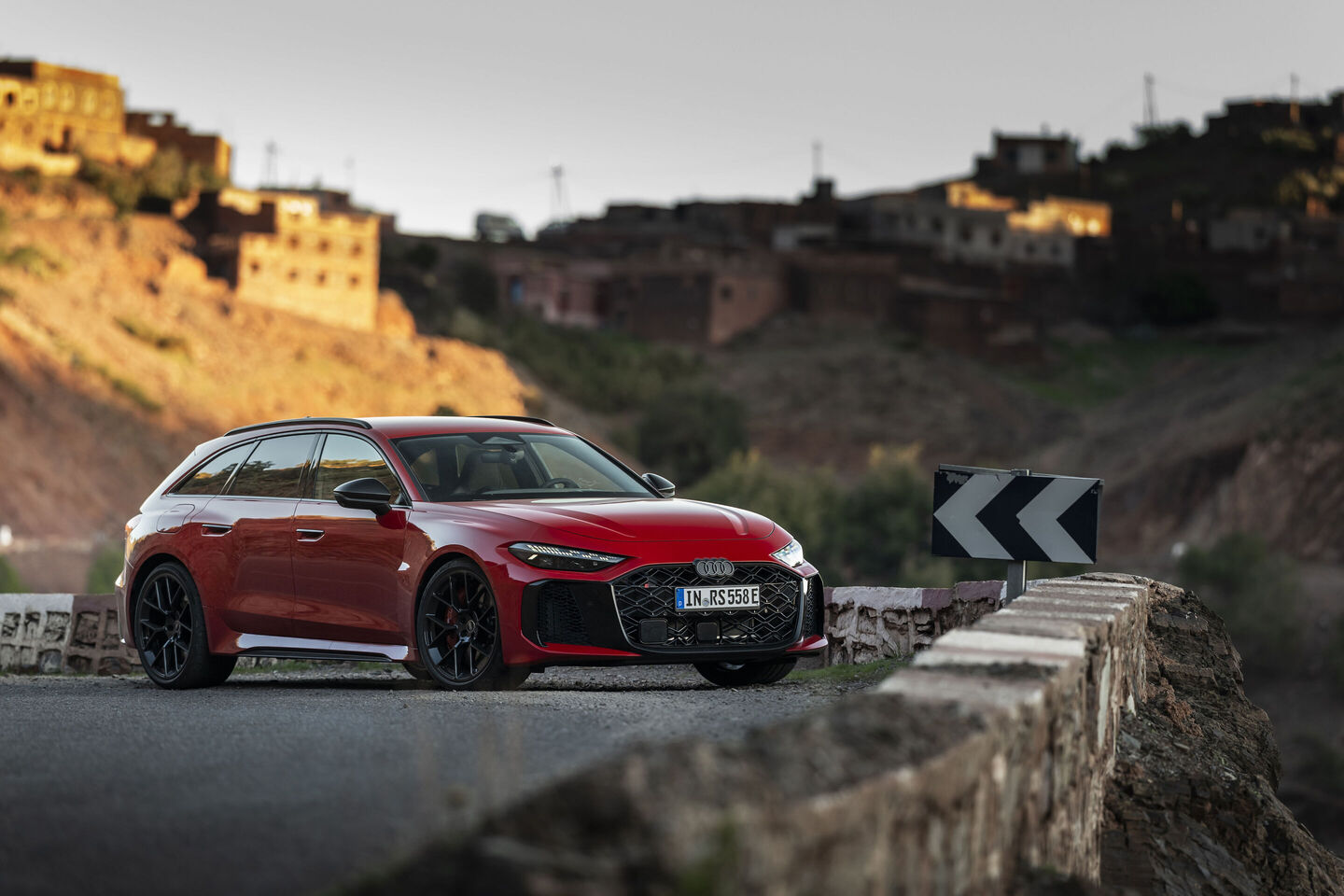
Audi has always owned the “fast estate” aesthetic, and the RS 5 Avant might be their most aggressive iteration yet. It does not try to hide its performance credentials. The widebody stance is immensely flared, looking like it barely fits within standard highway lanes.
Up front, the Singleframe grille has grown flatter and wider, flanked by massive, highly functional air intakes. The matrix LED headlights carry a sinister, darkened housing. Walking around to the side, the long roofline slopes into a heavily redesigned rear end featuring the signature RS oval exhaust pipes—which are larger than ever—and a pronounced rear diffuser.
In the hero “Progressive Red” metallic paint, it looks like it’s doing 100 mph while parked. It is unashamedly muscular, maintaining the perfect balance between premium executive transport and outright DTM race car.
Powertrain & Specs: The Heavyweight Dancer
Under the bonnet lies a 2.9-liter twin-turbo V6 engine, but the real headline is what it’s paired with. Audi Sport has integrated a 130-kW electric motor to create their first-ever high-performance PHEV.
The combined system output is a staggering 375 kW (510 PS). When you mash the throttle, the electric motor fills in the turbo lag instantly. There is no hesitation, no waiting for boost to build. It just squats and launches, obliterating the 0-100 km/h sprint in 3.6 seconds.
| Engine Configuration | 2.9-liter Twin-Turbo V6 + 130 kW Electric Motor |
| Total System Power | 375 kW (510 PS) |
| V6 Max Torque | 600 Nm (442.5 lb-ft) @ 2,000–5,000 rpm |
| 0–100 km/h (62 mph) | 3.6 seconds |
| Top Speed | 250 km/h (155 mph) / 140 km/h on Electric |
| Electric Range (WLTP) | 75 – 86 km (46 – 53 miles) |
| Drivetrain | quattro with Dynamic Torque Control |
| Weight (With Driver) | 2,445 kg (5,390 lbs) |
Driving Experience: Beating Physics with Code
Straight-line speed is easy to achieve with electric assistance. The real question is how a 5,400-pound wagon behaves when you throw it into a hairpin corner. The answer lies in a world-first technology for Audi: quattro with Dynamic Torque Control.
Audi has installed a brand-new rear transaxle featuring electromechanical torque vectoring. Instead of just braking the inner wheel to help the car turn, this system actively and mechanically shifts torque between the rear wheels in just 15 milliseconds.
The dreaded Audi understeer is completely gone. Brake late, point the nose, and get on the gas early—the rear axle physically pushes you through the curve. It feels composed, agile, and remarkably rear-biased when pushed hard.
Paired with bespoke RS sport suspension utilizing twin-valve shock absorbers, the RS 5 Avant manages its mass brilliantly. You do feel the weight under heavy, sustained braking, but in transition, the car feels 1,000 pounds lighter than it actually is.
Interior & Practicality: The 50-Mile Secret
Inside, it’s typical Audi RS perfection. Heavily bolstered bucket seats, carbon fiber trim, and an updated Virtual Cockpit that prioritizes performance telemetry. But the true party piece of the RS 5 Avant is its duality.
Because it’s a plug-in hybrid, you get up to 86 kilometers (about 53 miles) of pure electric range. That means you can do the school run, commute to work, and sit in city traffic in complete silence without burning a drop of fuel. When you want to be a civilized luxury wagon, it glides effortlessly. When you press the RS mode button on the steering wheel, the V6 barks to life, the dampers stiffen, and it transforms into a monster.
The Real-World Critique
Why You Should Consider It
If you need one car to do absolutely everything. It is a silent, tax-efficient electric commuter on weekdays, a spacious family hauler for holidays, and a 510-hp supercar-baiting weapon on canyon roads.
Why You Might Skip It
If you are a hardcore driving purist who values lightweight chassis feel above all else. If you want a raw, unassisted driving experience, a 2.4-tonne hybrid computer on wheels isn’t for you.
The Audi RS 5 Avant had a monumental task: replace the beloved RS 4 while navigating strict modern emissions regulations. Has it lost a bit of the old-school, analog charm? Yes. The V8 rumble is history, and the weight penalty is severe.
But here is the reality: compared to its main rival, the Mercedes-AMG C63 Estate, Audi absolutely nailed the brief. While AMG alienated buyers with an overly complicated, highly-strung four-cylinder, Audi smartly retained the muscular V6 and used the hybrid system to enhance the car’s dynamics rather than just meet quotas.
The RS 5 Avant is an absolute triumph of modern engineering. It is brutally fast, looks spectacular, and offers a breadth of capability—from silent EV commuting to track-day hooliganism—that very few cars in the world can match. The fast estate isn’t dead; it just evolved.